Prop account rules: is your strategy even eligible?
Prop accounts get shopped on two numbers: the drawdown width and the monthly price. Neither one can delete a strategy. A session rule can, and it does it completely.
So here is the rule everybody thinks they understand. Topstep says "No swing trading." Take Profit Trader says positions "may not be held from one session to the next." Apex prohibits "holding open trade positions through the market close," on pain of forfeiting the account and all its balances. Read those three lines and you would conclude that an overnight strategy is dead at all three firms.
That conclusion is wrong. The futures trading session does not start in the morning. It starts the evening before. Topstep's weekday session opens at 5:00 PM CT and closes at 3:10 PM CT the next day. Take Profit Trader's runs 6:00 PM ET to 5:00 PM ET. Apex's runs 6:00 PM ET to 4:59 PM ET.
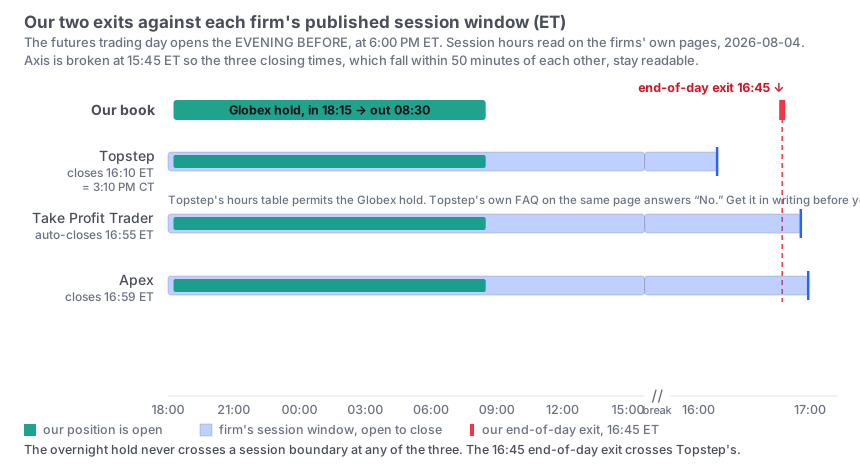
Our overnight strategy enters at 18:15 ET and exits at 08:30 ET. It crosses the calendar day. It does not cross a single one of those session boundaries.
On our book, that distinction decides 17.5 percent of net profit. Same strategy, same trades. Whether it is eligible or forbidden depends entirely on whether "overnight" means "past midnight" or "past the session close", and the firms mean the second one.
Check the firm's published session hours, not the word "overnight". The session opens the evening before, so a hold that runs from evening into the next morning never leaves the session it started in.
Whose trades are these
One systematic NQ book: five rules-based strategies running a single position at a time on
Nasdaq 100 futures. Window 2011 to 2026, data as of August 5, 2026. From the TradingView
List-of-Trades export STS_v8_[RNORM]_CME_MINI_NQ1!_2026-08-05.csv: 3,500 closed
trades, net $1,112,232.40, on a $100,000 nominal basis, NQ mini sized 1 to 3 contracts by volatility.
The numbers here are a property of a momentum book that holds trades for hours, not minutes. A scalper who is flat by 10 AM is eligible almost everywhere and can stop reading. The method transfers to any trader. The exact percentages do not.
What each strategy is worth, and which one is in question
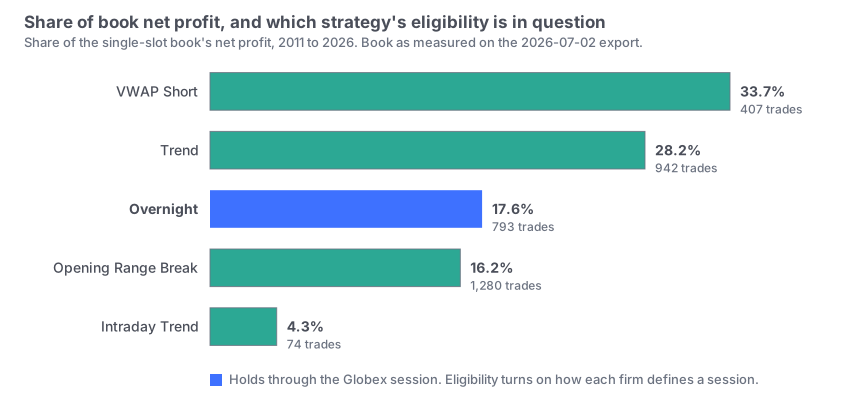
| Strategy | Trades | Share of book net |
|---|---|---|
| VWAP Short | 409 | 32.4% |
| Trend | 945 | 29.4% |
| Overnight | 793 | 17.5 percent |
| Opening Range Break | 1,282 | 16.3% |
| Intraday Trend | 71 | 4.3% |
One caveat on that table. These are shares of net profit earned inside the single-slot book, where the five strategies compete for one position. That is a different basis from the standalone per-strategy figures on our strategies page, where each runs alone with no contention. We do not mix the two bases. The in-book basis is used throughout, because it is what a subscriber following the signals would actually have traded. How each of the five works is published in full.
The session boundary, firm by firm
Our overnight strategy's shape is fixed: in at 18:15 ET, out at 08:30 ET. The question is only whether that path crosses each firm's session boundary. Draw the day on one clock and the answer stops being a reading comprehension exercise.
| Firm | Session as the firm publishes it | Does an 18:15 to 08:30 ET hold cross it? |
|---|---|---|
| Topstep | Opens 5:00 PM CT, closes 3:10 PM CT next day | No. Both ends sit inside one session. |
| Take Profit Trader | 6:00 PM ET to 5:00 PM ET, auto-close 4:55 PM ET | No. TPT counts a trade opened at or after 6 PM ET toward that new trading day. |
| Apex | 6:00 PM ET to 4:59 PM ET | No. The position never sits through the market close. |
On the published hours, the strategy survives at all three. But one of the three contradicts itself on exactly this point, and it is the firm most traders start with.
Topstep's own help page answers the literal question, and answers it "No." The FAQ on its trading-hours article asks: "Can I swing trade or hold positions overnight?" The answer: "No. All positions must be closed by 3:10 PM CT each weekday. Topstep does not permit holding positions from one session to the next."
Look at the justification it gives. Closing by 3:10 PM CT, and not crossing sessions. Neither one forbids our 18:15 to 08:30 hold under Topstep's own hours table on the same page. The one-word answer does.
We are not going to resolve that for you, because we cannot. Topstep's hours table and Topstep's FAQ point in opposite directions on the same page, read on 2026-08-04.
If your strategy holds through the Globex session, get an answer in writing from Topstep support before you pay. A screenshot of their reply is worth more than any article, this one included.
Apex and Take Profit Trader are cleaner. Apex's prohibition is anchored to a specific event, the market close, and our strategy is never open at it. TPT's is anchored to the session and defines the session start explicitly enough that the answer falls out.
The force-close deadline is the rule nobody checks
The overnight question is the one traders ask. The deadline question is the one that quietly reshapes an intraday book, and almost nobody checks it.
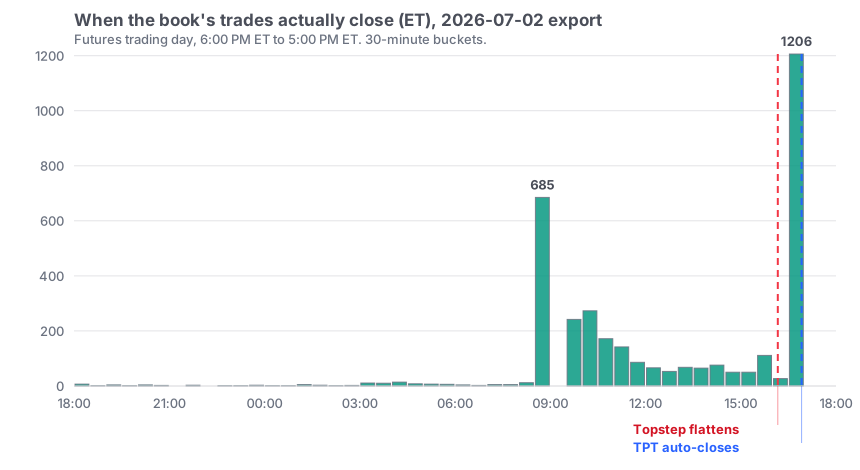
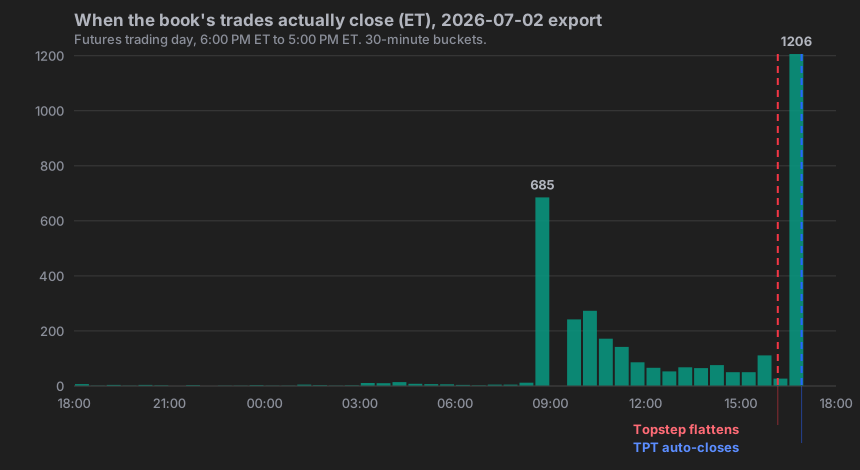
Our book's end-of-day exit fires at 4:45 PM ET. Line the three firms up against it:
| Firm | Force-close time | Our 4:45 PM ET exit |
|---|---|---|
| Topstep | 3:10 PM CT, which is 4:10 PM ET | Closed 35 minutes early |
| Take Profit Trader | 4:55 PM ET auto-close | Fits, with 10 minutes to spare |
| Apex | before 4:59 PM ET | Fits |
2,026 of our 3,500 trades, 57.9%, are not closed before the 4:10 PM ET flatten. Those trades carry 95.2% of the book's gross profit. Read that definition literally: it counts every trade that was not already closed on its own entry day by 4:10 PM ET, which includes the 793 overnight trades that enter at 6:15 PM ET and are never open across a 4:10 flatten at all. The narrower quantity, trades genuinely open ACROSS 4:10 PM ET, is 1,233 of 3,500, 35.2%, carrying 78.1% of gross profit. The two are different questions and we do not mix them.
Now the honest part. We cannot tell you what those trades were worth at 4:10 PM ET. Our export records the entry, the exit, and the best and worst the trade ever looked. It does not record a mark-to-market at an arbitrary timestamp. So we can tell you precisely how many trades a 4:10 PM deadline interrupts, and we refuse to estimate what the interruption costs. Anyone who hands you that number without intraday data invented it.
What is safe to act on is directional, and it is enough. A deadline that reaches 57.9% of your trades before your own exit logic fires is not a detail. It is a different strategy. And this one is not about overnight at all. It hits the intraday strategies, the ones everybody assumes are safe everywhere. The hour-by-hour breakdown of where a book's profit falls across the trading day is in when NQ actually pays.
The overnight rule is the one traders check, and on published hours it does not bite. The force-close deadline is the one nobody checks, and it reaches 57.9% of our trades. Take your own latest exit time, convert it into the firm's timezone, and compare it to their flatten time before you buy anything.
Intraday trailing punishes exactly the trades you want
The third eligibility question is the drawdown mechanic. All three firms use a $2,000 trailing drawdown on a 50K account, so the width decides nothing. What differs is what moves the floor up. An end-of-day trailing drawdown ratchets on your closing balance. An intraday trailing drawdown ratchets on your peak balance including unrealized gains. Apex states it plainly: "The threshold is enforced in real time, including unrealized PnL."
That is a tax on one specific kind of trade: the one that runs far in your favour and gives some back. A trade that reaches +$1,400 and closes +$600 has, under an intraday trail, permanently lifted your floor by the full $1,400 while paying you $600. You banked $600 and spent $1,400 of buffer.
Our book is full of those by design. The median winner peaks at 41.1 points of favorable excursion and closes at 24. That gap is not a defect to optimise away, it is what a trend-continuation exit looks like.
Measured trade by trade rather than as two separate medians, the same pattern holds across all 1,591 winners in the book.
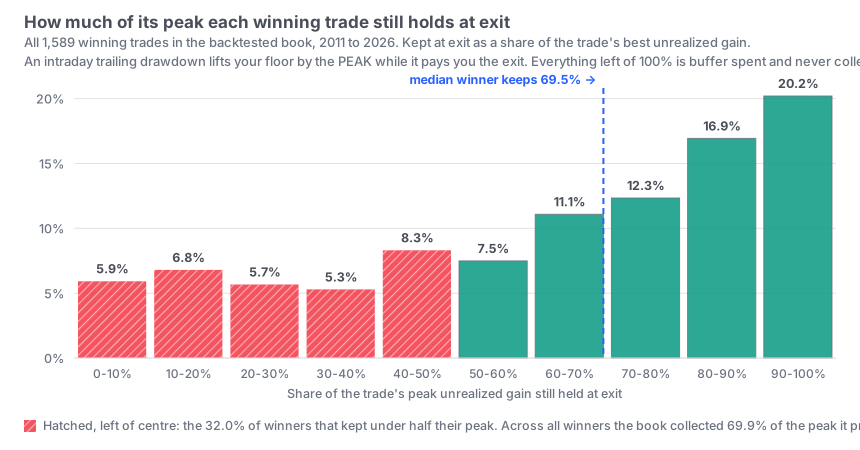
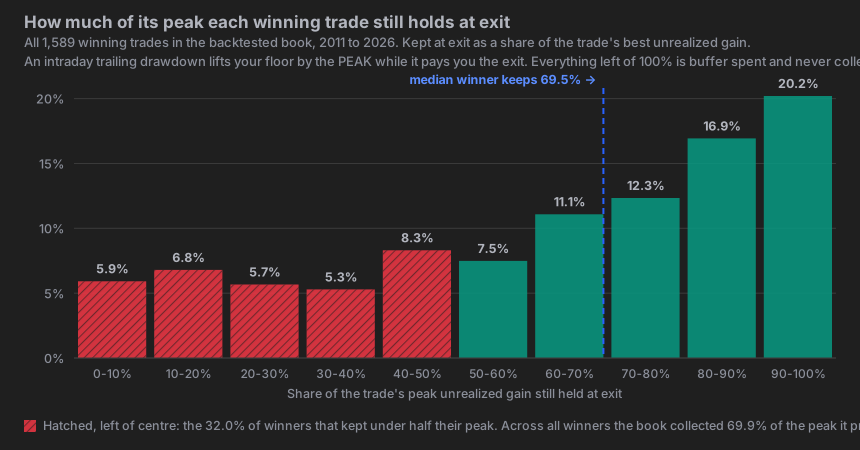
A book shaped like that consumes an intraday trailing buffer far faster than its closed-trade equity curve suggests, because the floor ratchets on profit the account never banked. If you trade a high-excursion system the end-of-day product is the structurally friendlier one, and at Apex that is a product choice made at purchase which cannot be converted later. We replayed the same book against every current 50K product's floor and lock point in three prop firms tested on our book. The lock point, not the brand, decided survival.
Width tells you nothing. The question is whether the floor ratchets on your closing balance or on your unrealized peaks. A trend-continuation book gives back a third of its peak profit by design, and an intraday trail charges you for every point of it.
Whether you can physically place the order is a rule too
A strategy you cannot physically place is as ineligible as one the rules forbid. We ship our signals as an invite-only TradingView script, so this one is close to home.
| Firm | TradingView order entry | Automated execution, funded stage |
|---|---|---|
| Topstep | Not supported, at any stage | Permitted with conditions; not via the ProjectX API on a Live Funded Account |
| Take Profit Trader | Yes, and free during the Test, on a CQG feed | Prohibited. "No Trading Bots or Algos" |
| Apex | Yes, but only via Tradovate | Prohibited. "No Automation or Algorithm Usage allowed" |
Two of the three prohibit automation outright at the funded stage, in their own words. Apex: "Rewards are intended to recognize human traders actively participating in the learning process, not to reward automated systems executing preprogrammed logic." Take Profit Trader, in policies that explicitly cover Test, PRO and PRO+: "Automated trading systems, bots, or algorithmic execution tools are not permitted."
Reading signals off a chart and placing the orders yourself is not automated execution, and the bot rules are not aimed at you. But the platform rule is: on Topstep you cannot put our script and your order ticket in the same window, at any stage. TopstepX "cannot connect to external platforms like TradingView." That is not a preference, it is the product.
What to do before you pay
Four questions, in this order, all answerable in an afternoon.
One: what does this firm call a session, and when does it start? Not what "overnight" means to you. What the session boundary is on their published hours page. That definition, not the word, decides whether a Globex strategy lives.
Two: what time is my last exit? Not the average, the latest. Compare it to the firm's force-close time in one timezone. Most deadlines are published in CT and most charts are in ET, and that one-hour slip is where people get caught.
Three: how much does my average winner give back from its peak? If the answer is "a lot", an intraday trailing drawdown is charging you for profit you never collected. Prefer end-of-day where you get the choice, and remember the choice can be permanent.
Four: can I physically place the order from the tool I actually use? Check before you pay. Platform choice at Apex cannot be converted later and is explicitly non-refundable.
None of these is the number on the pricing page. All four can disqualify you.
Clearing all four only makes you eligible. Whether money ever leaves the account is decided by a second rulebook that no evaluation page shows you. We took that one apart in getting funded is not getting paid.
The limits of this analysis
Every rule here was read on the firm's own live page on the date stamped beside it, and the source pages are linked at the end. Prop firms change rules without notice. Apex re-ruled its entire product line on 1 March 2026 and is currently re-selling a legacy product with different numbers under a promotion.
All three firms contradict themselves across their own pages on at least one rule, and one of those contradictions is load-bearing here. Re-read the rule yourself before acting on it. We are not affiliated with any prop firm.
On our side: the strategy shares are the in-book, single-slot basis on the 2026-08-05 export. An automated reconciliation gate cross-checks them to the canonical net of $1,112,232.40 and 3,500 trades, and refuses to draw the charts if the parse drifts.
We publish those shares as percentages only, so this article does not introduce a second per-strategy dollar basis alongside the standalone figures already on the site. The peak-giveback figures are per-trade ratios of net profit to the export's own favorable-excursion column, taken over the 1,591 winning trades. They are percentages by construction and carry no dollar basis at all.
Exit times are exchange time. We do not estimate the cost of an early force-close, for the reason given above. All of this is hypothetical backtest performance, not a live account and not a payout record.
The eligibility question is the one part of prop-account selection that is fully knowable in advance, from published rules and your own trade export, with no forecasting involved. It is also the part most traders skip, and the part where the published rules are least careful.
Where these rules came from
Every firm rule above was read in a browser, on the firm's own live page, on the date stamped beside it. No search snippets, no cached pages, no third-party comparison sites: prop firms retire rules faster than the rest of the web catches up, and a retired rule reads exactly like a current one. The pages this article works from:
- Topstep: trading hours and products, TopstepX, Express Funded Account parameters
- Apex: prohibited activities, futures trading times, intraday trailing drawdown explained
- Take Profit Trader: Universal Trading Policies, trading hours, TradingView support
Any of these can change tomorrow with no announcement. Read the page yourself before you pay, and if it now says something other than what is quoted here, the firm's page wins.
Every trade behind these numbers is on the tear sheet, the strategies are on our strategies page, and the signals are what we sell.
Disclosure. We trade this book live and sell access to the signals, so judge the data accordingly. This article is educational and is not investment advice, a recommendation, or an offer to buy or sell any security or futures contract, and it is not a recommendation of any prop firm or account type. We have no affiliation with Topstep, Apex Trader Funding, Take Profit Trader, or any prop firm. Every rule cited was read on the firm's own live page on the date shown and can change at any time.