The best time to trade NQ futures: which system fires each hour
The best time to trade NQ futures around a day job is 6 PM ET. In the STS NQ book of five systems, exactly one fires after work: the overnight model that enters at the 6 PM ET reopen and made 17.5 percent of the book's profit ($195,138 in the 18 ET window, STS backtested book, 2011 to 2026). The other four fire during market hours, and most of that money lands in a single hour, the 9 ET open, which made 60.1% of the total. If your only free time is after work, the overnight sub is the one slice you can trade. Below we map every hour to the system that owns it.
Our hour-by-hour breakdown of the NQ market open showed which hour makes the money. This one answers the next question we kept getting: which of the five strategies owns each hour, and how much of it can I actually trade if I am at a desk from 9 to 5? We took the same 3,500 trades and split every entry timestamp by strategy.
Whose trades are these (read this first)
These numbers are from the STS NQ book: five systematic NQ strategies run as one single-position portfolio. TradingView backtests, 2011 to 2026, one to three contracts scaled by volatility, commissions and slippage included, $1,112,232 net over 3,500 trades.
The five systems are S1 Trend (a morning long), S2 ORB Long (an opening-range breakout), S3 Short (the down-move system), S5 Overnight (the 6 PM reopen model), and S6 Universal Trend (a late-morning trend sub). Four of the five trade the long side, and 86.6% of all book trades are longs (3,032 of 3,500). Each was built to enter at specific times on purpose. So this shows where our setups fire, not a free property of the NQ market. What you can copy is the method and the schedule logic. The exact hours are ours.
Which system owns each hour
Here is the whole book, every entry, counted by hour and colored by which system made it.
| Entry hour (ET) | S1 Trend | S2 ORB | S3 Short | S5 Overnight | S6 Universal | Book trades |
|---|---|---|---|---|---|---|
| 9 | 944 | 781 | 185 | - | 110 | 1,595 |
| 10 | - | 460 | 121 | - | 132 | 509 |
| 11 | - | 152 | 40 | - | 77 | 231 |
| 12 | - | 72 | 14 | - | - | 105 |
| 13 | - | 68 | 18 | - | - | 101 |
| 14 | - | 77 | 30 | - | - | 115 |
| 15 | - | 43 | 4 | - | - | 50 |
| 18 | - | - | - | 796 | - | 793 |
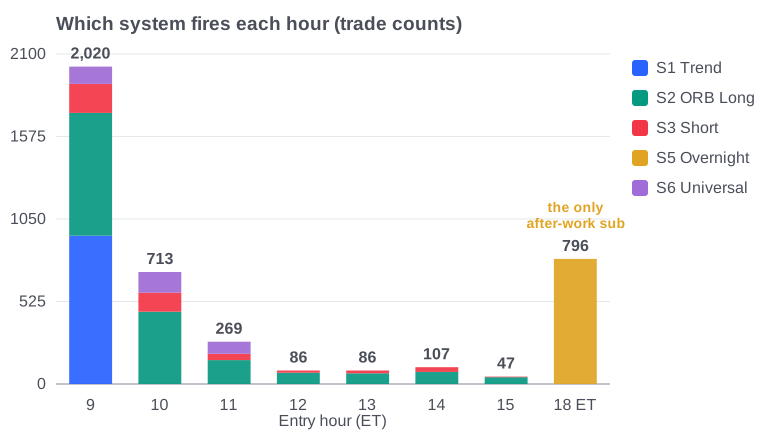
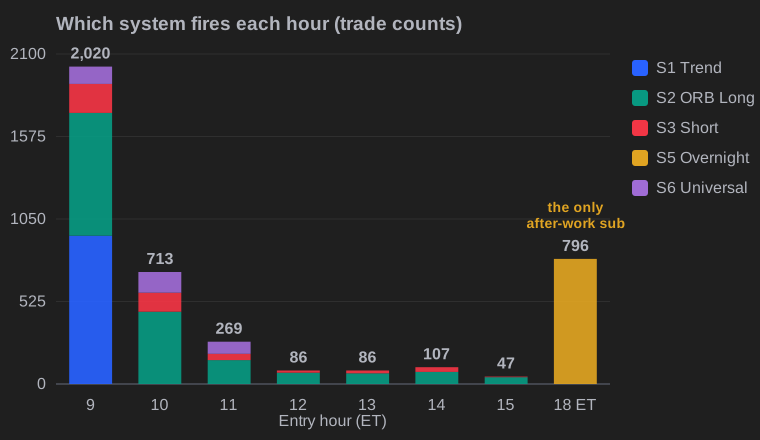
The picture is clean once you see it in color. The 9 ET bar is tall because four different systems all fire there. The 18 ET bar is tall because one system, the overnight sub, fires 796 times and nowhere else. And the dead middle of the day, 12 to 13 ET, is a thin scatter of the breakout and short subs winding down.
One honest wrinkle. These sub counts are each system's standalone trade list. The book is a single-position portfolio, so when two systems signal into the same slot the engine nets them. That is why the standalone counts do not sum exactly to the book column (the 9 ET subs add to 2,020, the book records 1,595 there). The stacked counts tell you which engine owns each hour. The book column is the realized truth. We think the "which engine" read is the useful one, so that is what the chart shows.
The money each system makes, hour by hour
Counts tell you when a system is busy. Dollars tell you when it matters. Two systems carry the profit at the open, and they could not be more different. The per-system dollar figures in this section are each strategy run standalone, backtested through June 2026; the book-level shares are the combined portfolio as of August 5, 2026.
S3 Short is the giant at the open. Its 185 trades entered in the 9 ET hour made $225,458, an average of $1,219 per trade, at a profit factor of 2.49. That is the biggest per-trade number in the whole book. The short system wins less than half the time and still prints, because when a morning breaks down it breaks down hard. This is the system doing the real work in the down years.
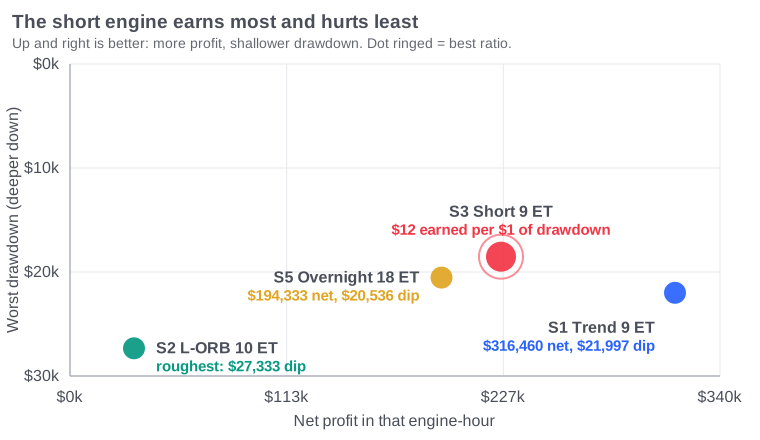
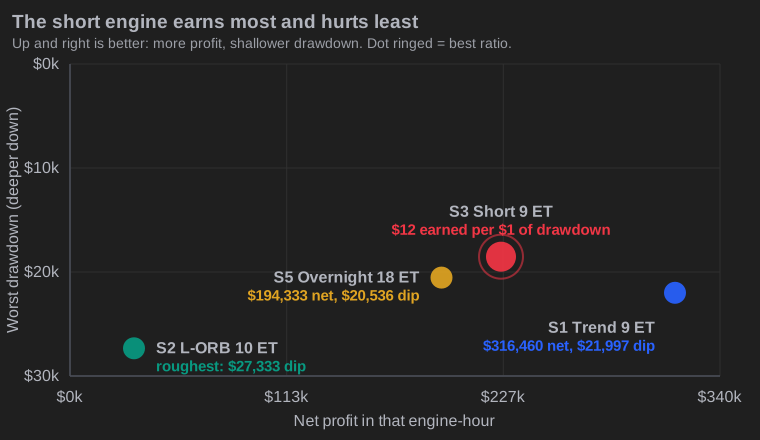
And it earns that money quietly. We took the book's own trades, tagged each by which engine fired, and tracked the worst peak-to-trough dip inside each engine's 9 ET hour. S3 Short's dip was only $-18,526 against its $225,458, about twelve dollars earned for every dollar of drawdown. That is the best money-to-pain ratio of any engine-hour in the book. The long engines pay more to hold: S1 Trend rides a $-21,997 dip at the same open for its $316,460, and the L-ORB breakout is the roughest of all at $-27,333 for just $33,458 in its 10 ET hour. The after-work overnight sub sits in between, $194,333 against a $-20,536 dip. So the open's headline is carried by the short engine, and the short engine is also the calmest thing firing there.
S1 Trend is the workhorse. All 944 of its trades fire in the 9 ET hour, none anywhere else. It wins only 34% of the time and still made $316,460, because the winners run. It is the clearest example of the thing the first article found: the open pays by being wrong often and right big.
S6 Universal splits its money across the late morning. Half its profit comes from the 9 ET hour, but a third comes from the 11 ET hour, $57,877 at a 58% win rate. It is the one morning system that keeps earning after the open drive is done.
S2 ORB Long spreads thin and slow. It is the busiest RTH system, 1,653 trades across seven hours, but it earns the least per trade. One 68-trade window at 13 ET prints its best-looking average, $598 a trade at a 2.31 profit factor, but that number leans on a single trade (80% of the hour's net) and is not statistically distinguishable from zero, so read it as noise, not a window to target. The real story of S2 is the opposite: most of its money is a lot of small edges added up, not one strong hour.
S5 Overnight is the clean one. Every trade fires at the 6 PM reopen. It wins 56.3% of the time, its profit factor is 1.57, and its standalone list made $194,333 without ever asking you to watch the open. Inside the combined book, the same 6 PM window is 17.5 percent of all profit, $195,138 on the August 5, 2026 basis. Of all five systems it is the calmest to follow, and it is the only one that fits a normal workday. Its full 796-trade record, and the correlation number that earns it a slot, are in our NQ overnight strategy backtest.
| System | Busiest hour | Best hour by avg $ | Total net | Win rate |
|---|---|---|---|---|
| S1 Trend | 9 ET (all of it) | 9 ET, $335 | $316,460 | 34.0% |
| S2 ORB Long | 9 ET | 9 ET, $159* | $284,206 | 49.8% |
| S3 Short | 9 ET | 9 ET, $1,219 | $382,003 | 40.8% |
| S5 Overnight | 18 ET (all of it) | 18 ET, $244 | $194,333 | 56.3% |
| S6 Universal | 10 ET | 11 ET, $752 | $160,982 | 51.4% |
Best hour by average dollars shows each system's best statistically reliable hour. S2's highest raw average is 13 ET at $598 a trade, but on 68 trades that is not distinguishable from zero, so it is excluded as noise.
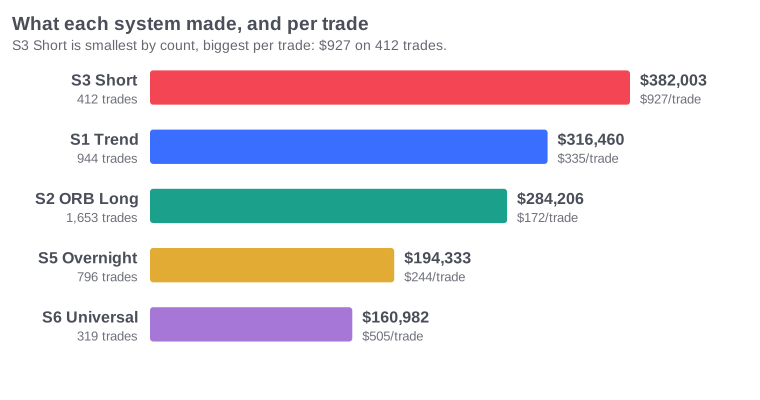
The open hour is not one edge, it is four systems stacked, and the short sub carries it with $1,219-a-trade wins. The 6 PM reopen is a single quiet system you can trade after work.
Around a day job, one system reaches you: the 6 PM sub
Here is the schedule question answered straight, in dollars.
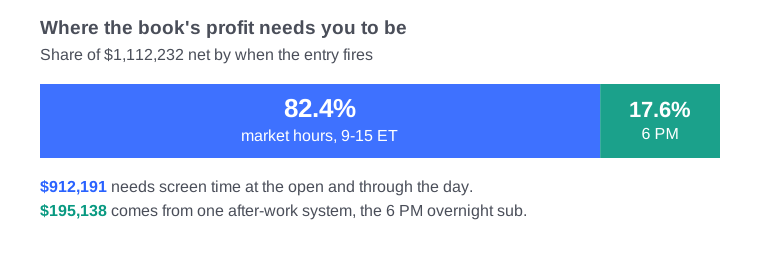
Evening only, after work. If the earliest you can trade is when you get home, you are looking at the 6 PM reopen and nothing else. That is the S5 Overnight system: 17.5 percent of the book's profit, $195,138 in the 18 ET window, at a 56% win rate. One signal window a day, no market-hours screen time, and the smoothest of the five. It will not make you the whole book. It makes a real, clean slice of it, on a schedule a working person can keep.
The open, if you can get ten minutes at 09:40. The 9 ET hour holds 60.1% of the profit, and the entries cluster at 09:40 (more on that below). If you can step away from a desk for a few minutes around 09:40, that one window is where most of the money is. It is also the hardest to trade well, because it holds our lowest win rate, 38.4%. You have to sit through being wrong to catch the big winners.
A lunch break buys you almost nothing. If your only free moment is midday, the 12 to 13 ET window made just 3.0% of profit, and noon (12 ET) is the deadest hour in the book at a 1.29 profit factor. The opening drive is over and the afternoon has not started. Trading your lunch hour out of a sense that you should be doing something is the most expensive habit in this whole dataset.
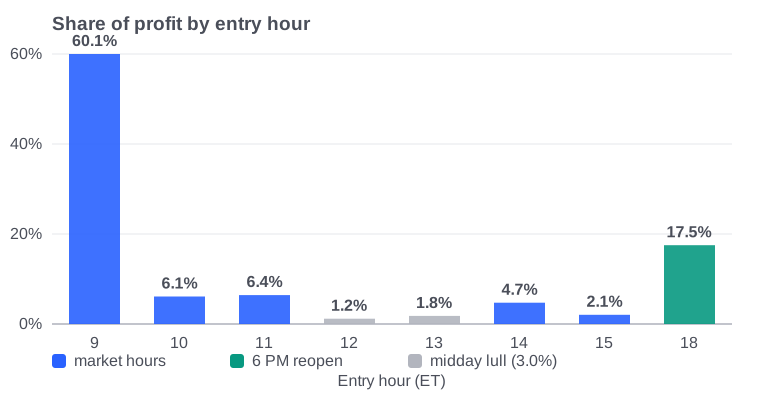
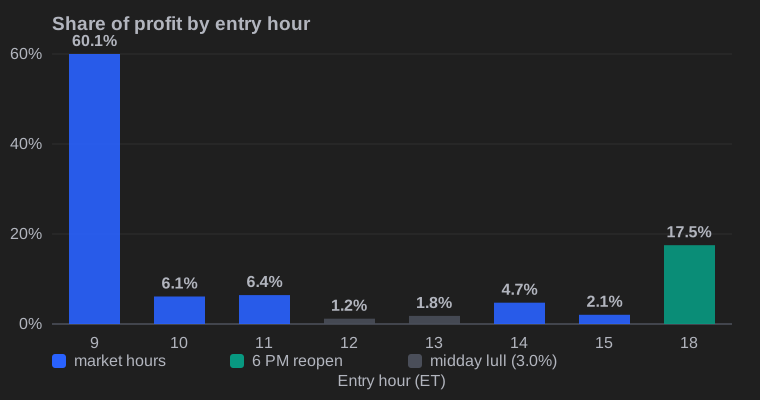
So the clean read: 82.5% of our profit needs someone at a screen during market hours, and 17.5 percent is reachable after work through the one overnight system. An evening-only trader lives on the overnight sub. Free up the 09:40 open and the bulk swings into reach.
The open holds in every market, but a different engine carries it in a crash
A fair worry about "60.1% of profit is in one hour" is that the hour only works in calm markets. It does not. We joined every 9 ET trade to its exit-month volatility regime and the open came out net-positive in all five regimes, though the strength of that read varies: only the trend-up regime clears a firm significance bar, high-vol up is marginal, and the chop, crash and calm-down cells are net-positive but rest on smaller, fat-tailed samples that on their own do not clear it. What changes across regimes is not whether the sign is green. It is which engine does the winning.
In the high-volatility up regime the open made +$118,779 across 144 trades at a 1.87 profit factor, and 81% of that came from S1 Trend running with the tape. In the crash regime, the high-volatility down months, the open still came out +$104,200 across 275 trades, but that whole panel is thin and fat-tailed, below a significance bar, so treat it as directional color, not a proven rule. What we can see is a hand-changing: the short engine's few crash-hour trades (13) carried it, +$63,352, though that leans on a handful of 2018 and 2021 fills, while the long breakout was roughly flat over the same months (-$19,853 on 61 trades, not distinguishable from a loss of nothing). The longs do the earning in the up move and the short shows up in the crash, so the hour has not needed a calm tape to stay green, but the crash-specific reads rest on small samples.
| 9 ET regime | Trades | Net | Win rate | Who carries it |
|---|---|---|---|---|
| High-vol up | 144 | +$118,779 | 40.3% | S1 Trend, +$95,823 |
| Crash (high-vol down) | 275 | +$104,200 | 31.6% | S3 Short +$63,352; L-ORB -$19,853 |
| Calm down | 71 | +$46,461 | 40.8% | S3 Short, +$49,900 |
| Trend up | 599 | +$161,669 | 40.6% | S1 Trend +$96,379; L-ORB +$71,953 |
| Chop | 374 | +$69,061 | 36.6% | S1 Trend, +$28,297 |
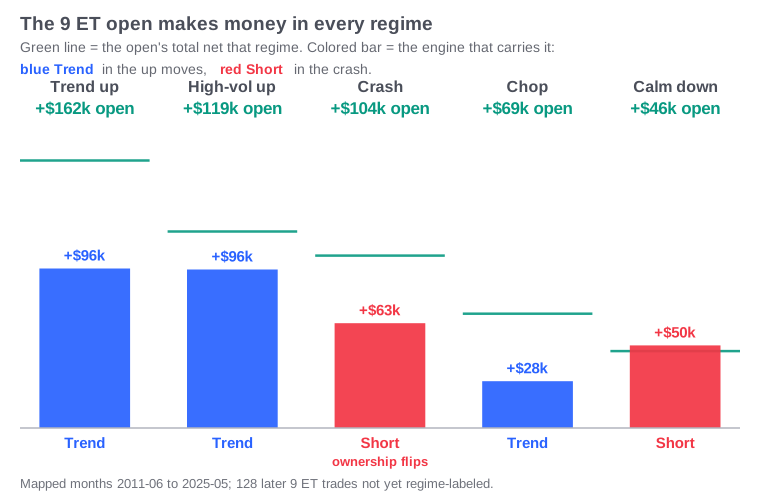
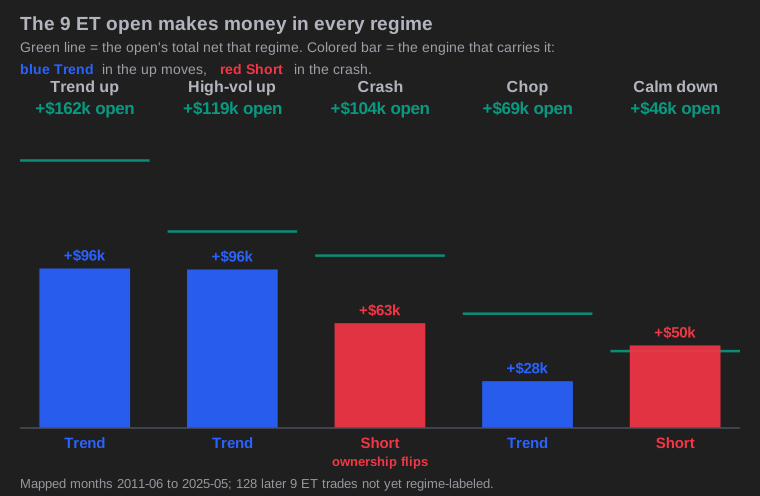
This is the practical reason the open is worth the pain of its 38.4% win rate. It is not one edge that needs a calm tape. It looks like a rotating edge: when the longs stop working the short engine picks up inside the same hour, which is likely why the window has stayed green across conditions that break a one-directional system. The crash-regime leg of that story is the thinnest (13 short trades), so treat the rotation as a well-supported tendency rather than a hard law.
One honest limit. Our volatility-regime map runs through 2025-05, so the 132 most recent 9 ET trades are not yet labeled and sit outside this table. Read the regime finding as a statement about the 14 mapped years, 2011-06 through 2025-05, not the last fourteen months. We will extend the map and re-run it.
The open trades fire at 09:40, not 09:30
Calling this the 9:30 cash open would be loose. Looking at the actual entry minutes, 1,034 of the 1,595 trades in that hour fire at 09:40, and the rest at 09:45, 09:50, or 09:55. Not one fires at 09:30. The systems wait ten minutes for the opening range and first bars to form before they commit.
The open trades fire in the hour after the 09:30 open, clustered at 09:40. The 6 PM reopen entries cluster the same way, at 18:15. If you are setting an alarm, set it for those two minutes.
Two windows, the open and the reopen, hold 77.7% of the book
Add the 9 ET open and the 18 ET reopen together and you get 77.7% of the book's profit in two windows. That is the same number we lean on in how to read the NQ and ES daily bias, where those two windows anchor the framework. The overnight sub matters for a second reason: its steady 56% win rate is part of what keeps the whole book's drawdown distribution smooth, and that distribution is what decides whether an account survives a losing stretch. We size against it in what a $25k account can actually hold.
Run the same split on your own log in a minute
If you keep your own trade log, export the list of trades and bucket the entry timestamps:
1. Keep only the entry rows (drop the exit rows).
2. Read the hour from each entry timestamp in exchange time (ET).
3. Group by that hour. Sum net P&L per hour, and divide by the total for the share.
4. To split by system, group by the system tag first, then by hour.
5. Schedule-fit: label 09:00-15:59 as market hours and 18:00 as after-work,
   then sum the two buckets. Ours came out 82.5 percent and 17.5 percent.
The only number that will not tie out cleanly is the standalone-to-book trade count, for the netting reason below. Every dollar figure will.
This maps our systems, not a free property of the NQ market
Be careful with the lesson. This shows where our systems fire, not where the NQ market is easy. Our strategies were built to enter at these times, so the table cannot tell you a 9 ET trade is good. Only that our 9 ET setups have been.
Two thin spots deserve doubt. The S3 short system's 15 ET row shows a huge profit factor on just 4 trades. That is noise, not a finding, and we treat anything under a few hundred trades as a hint. And the standalone sub counts do not sum to the book because of portfolio netting, so read the histogram as "which engine owns each hour," not as a second set of book totals. All of this is hypothetical backtest performance. Past performance does not indicate future results.
How we measured this
Instrument: CME Nasdaq-100 E-mini (NQ), $100,000 starting capital, no compounding, one to three contracts scaled by volatility, commissions and slippage included in the backtest. Data: our five-strategy book, backtested on TradingView, 2011 through August 5, 2026, 3,500 book trades, plus each of the five systems measured standalone (data through June 2026).
Method: for each trade, take the entry-row timestamp (exchange time, ET) and bucket by hour. Sum net P&L per bucket for each system and for the book, then divide by the total for the profit share. The full-book hour table reproduces the published figures digit-for-digit, and the per-system tables each reconcile to that system's standalone total. The one number that will not tie out is the standalone-to-book trade count, because the single-position portfolio nets overlapping signals; that gap is expected and documented.
The drawdown figures are the worst peak-to-trough dip inside each engine's own hour, computed on the book's own trades tagged by which engine fired, taken in exit order, not the book's realized drawdown. The regime table tags each of the book's own 9 ET trades by which engine fired and joins it to the exit-month volatility regime. Both the drawdown and regime numbers were recomputed by a second script written from scratch and agreed to the cent. The regime map covers 2011-06 through 2025-05, so 132 later 9 ET trades are unmapped and excluded from that table.
What we test next
Two cuts are queued. First, extend the volatility-regime map past 2025-05 so the last fourteen months of 9 ET trades get labeled and the crash-rotation finding covers the full record. Second, split the overnight sub by weekday, since an after-work trader lives entirely on that one system. If its Thursday and Friday behavior looks like the book's, where the back half of the week carries the profit (Wednesday through Friday hold 66.8% of it, and Thursday alone is the single best day at 26.4%), the schedule answer gets even cleaner. We will run both and report them, good or bad.
The full numbers, drawdowns and all, are on the strategy page and the backtested tear sheet. How NQ compares with ES for this style is in NQ vs ES futures. Our subscribers get every one of these entries as a real-time signal from the same five systems measured here, including the 6 PM overnight window that fits a working schedule. Plans are on the pricing page.
We trade this book live and sell access to the signals, so judge the data accordingly. This article is educational and is not investment advice. Futures trading involves substantial risk of loss and is not suitable for every investor.
Hypothetical performance disclaimer (CFTC Rule 4.41): hypothetical or simulated performance results have certain limitations. Unlike an actual performance record, simulated results do not represent actual trading. Also, since the trades have not been executed, the results may have under- or over-compensated for the impact, if any, of certain market factors, such as lack of liquidity. Simulated trading programs in general are also subject to the fact that they are designed with the benefit of hindsight. No representation is being made that any account will or is likely to achieve profit or losses similar to those shown. Past performance does not indicate future results.