Prop firm payout rules vs evaluation rules: getting funded is not getting paid
The evaluation has a scoreboard. A profit target, a drawdown number, a pass or a fail. It is legible, it is what the firm sells, and it is what traders study.
Withdrawal has none of that. Different rules, published on different pages. At two of the three firms we checked, at least one of those rules does not exist until after you are funded. Passing tells you almost nothing about whether money will come out.
Here is the shape of it, on our own backtested book.
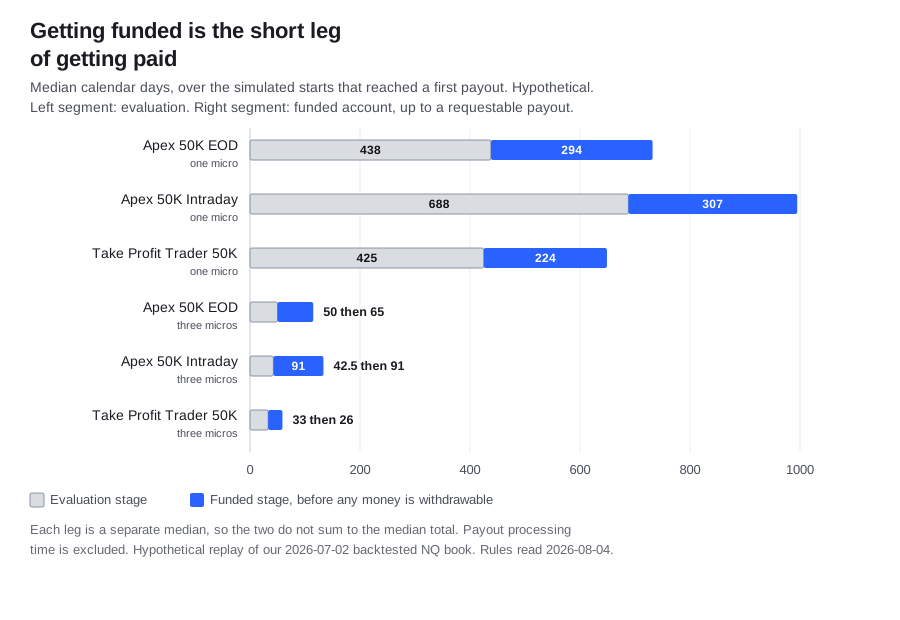
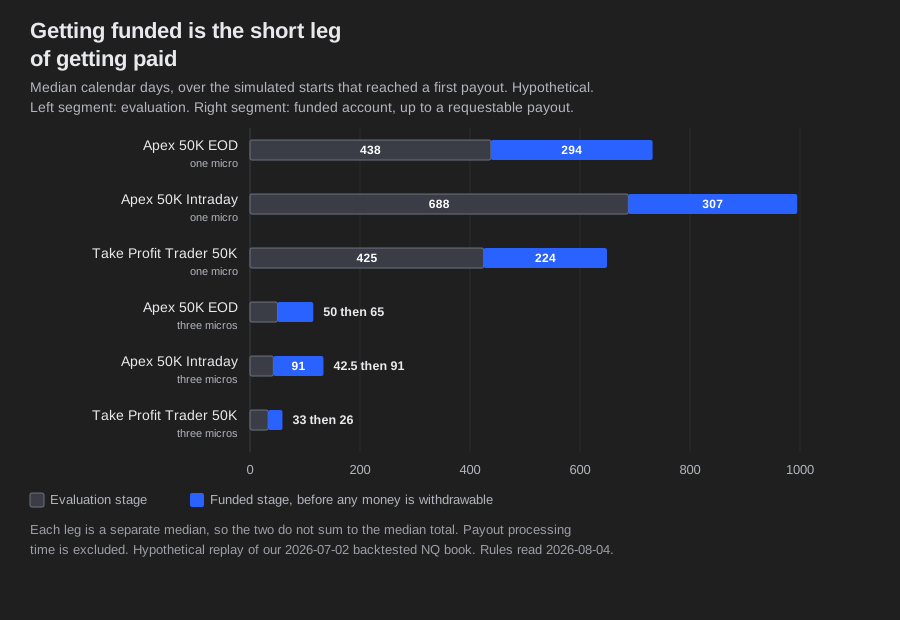
At three micros on Apex's intraday product, the median account spent 42.5 days getting funded and 91 days after that before a payout could even be requested. Getting funded was the short leg.
Whose trades are these
One systematic NQ book: rules-based strategies running a single position at a time on Nasdaq 100
futures, 2011 to 2026, data as of August 5, 2026. From the TradingView List-of-Trades export
STS_v8_[RNORM]_CME_MINI_NQ1!_2026-08-05.csv: 3,500 closed trades, net
$1,112,232.40, on a $100,000
nominal basis, NQ mini sized 1 to 3 contracts by volatility.
Everything below replays that exact trade sequence, scaled to MNQ micros, from each of the 2,540 historical days on which an account could have been opened. It is a hypothetical replay of a backtest against published rules, not a payout record and not a forecast.
The two rulebooks, side by side
Three rules govern the evaluation at every firm we checked: a profit target, a trailing drawdown, and a minimum number of trading days. Three different rules govern the withdrawal. They do not overlap with the first three at all.
A buffer. Apex calls it the Safety Net. On a 50K Performance Account it is $52,100, "must be maintained for the lifetime of the Performance Account." Only profit above it is eligible, and the minimum balance to request a payout is $52,600.
Take Profit Trader calls it the buffer zone and puts it at $52,000 on a 50K, paying out 80% once you are above it. Topstep's Express Funded Account has none. The balance starts at $0 and the requirement is "Positive net profit since your last Payout... at least $0.01."
Qualifying days with a dollar floor. This is the rule that surprises people. The evaluation counts days you traded. The payout counts days you made a specific amount.
Apex 50K EOD requires five days of at least $250 net each. Its page states that "only days that meet the minimum daily profit count toward the 5-day requirement." On the Intraday product the figure is $200. Topstep's XFA Standard path requires "5 winning days of $150+ Net P&L." A profitable day below the line is not a qualifying day. It is nothing.
A consistency cap that appears out of nowhere. Apex's own evaluation parameter table lists consistency as "Not Applied." Its payout page then says no single profitable day may account for 50% or more of total profit since the last approved payout. Until you satisfy it, "the payout request option will not be available."
Topstep applies a 40% cap, but only on its XFA Consistency path. The XFA Standard path and the Live Funded Account have no consistency target at all. At Take Profit Trader we could not verify a payout-stage consistency rule in either direction, so we do not assert one. See the sources table.
| Product | Evaluation stage | Withdrawal stage |
|---|---|---|
| Apex 50K EOD | Target $3,000. Drawdown $2,000. No minimum days. Consistency "Not Applied" | Balance at least $52,600. 5 days of $250+ net each. 50% consistency. First payout capped at $1,500 |
| Apex 50K Intraday | Target $3,000. Drawdown $2,000. Minimum 1 day. Consistency not applied | Balance at least $52,600. 5 days of $200+ net each. 50% consistency. First payout capped at $1,500 |
| Topstep 50K | Target $3,000. Drawdown $2,000. No published minimum, cannot pass in one day. 50% consistency, which raises the target rather than failing you | No buffer. Standard path: 5 winning days of $150+, no consistency target, 50% of balance capped at $2,000. Consistency path: 3 trading days, 40% cap, capped at $3,000 |
| Take Profit Trader 50K | Target $3,000. Drawdown $2,000, end-of-day basis. Minimum 5 trading days. 50% consistency | Balance at least $52,000. No minimum days published. No consistency rule found. No cap found. 80/20 split |
The two columns share no rules. Studying the evaluation teaches you nothing about the second set.
Read the two columns as a pair, not a progression. They are not the same test run twice. Take Profit Trader is the clearest example. The Test uses an end-of-day trailing drawdown, calculated once a day and not during open trades. The PRO account switches to an intraday trailing drawdown on peak balance including unrealized gains. Same $2,000, different mechanic, different stage, and neither page flags the change.
What the second rulebook costs
The two-stage structure has a consequence that never shows up in a pass rate: an account can clear the evaluation and then simply never produce money.
Replaying our book from all 2,540 historical start dates on Apex's 50K EOD product at one micro, 89.6% of starts passed the evaluation. 78.7% reached a first requestable payout. The gap is 12.2% of funded accounts that were funded and never paid. At three micros the same figure is 58.8%. At six micros it is 76.1%.
Those accounts did not fail an evaluation. They passed one, then spent their buffer, or never assembled five qualifying days before touching the floor. The floor is the same $2,000 trailing drawdown that governs the evaluation. Where it stops trailing decides most of the survival question, which we measured separately in three prop firms tested on our book.
A pass rate is not a payout rate. At one micro, 12.2% of funded accounts were funded and never paid. At six micros, 76.1%. Nothing on an evaluation page tells you the second filter exists.
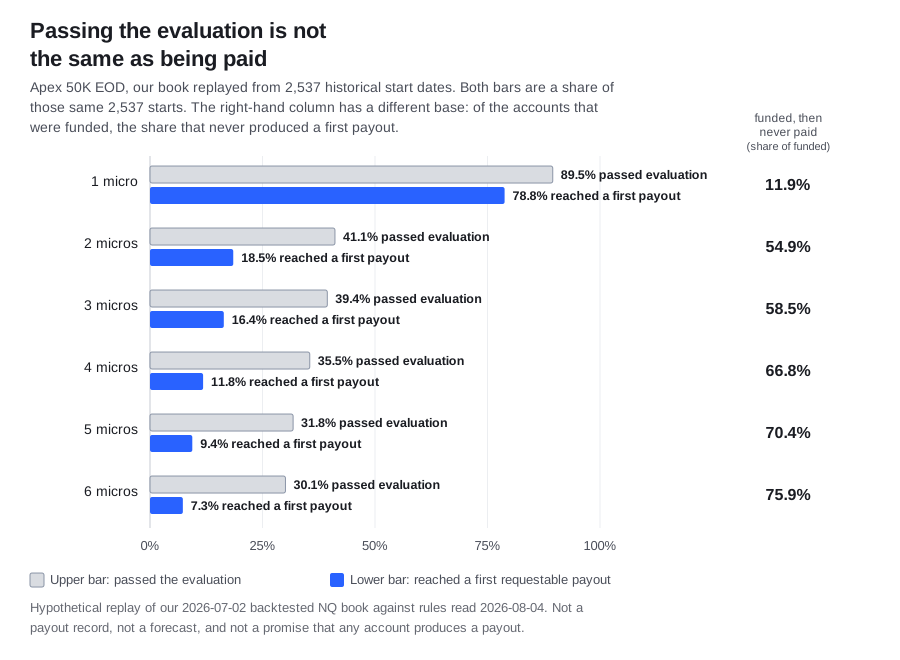
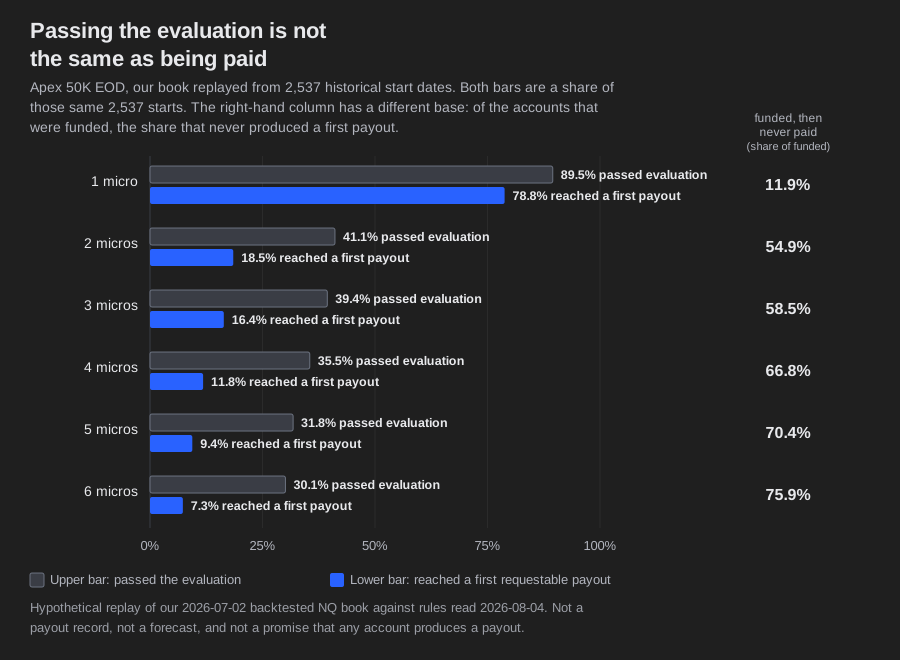
The evaluation is a filter the book mostly clears. The withdrawal rules are a second filter underneath it. Both get harsher as size rises, and no multiplier escapes both. That arithmetic is the optimal contract multiplier does not exist.
The consistency rule can be priced directly, because it exists at the payout stage and not at the evaluation stage. We ran the identical Apex EOD pipeline twice, same trades and same floors, with the 50% payout gate enforced and then ignored:
| Micros | Reached a first payout, gate on | Gate off | Median days, gate on | Gate off |
|---|---|---|---|---|
| 1 | 78.7% | 78.7% | 762 | 759 |
| 2 | 18.5% | 19.2% | 108.5 | 94 |
| 3 | 16.3% | 17.0% | 196 | 158 |
| 4 | 11.8% | 12.0% | 61 | 49.5 |
| 5 | 9.4% | 10.0% | 55 | 45.5 |
| 6 | 7.2% | 7.5% | 46.5 | 36 |
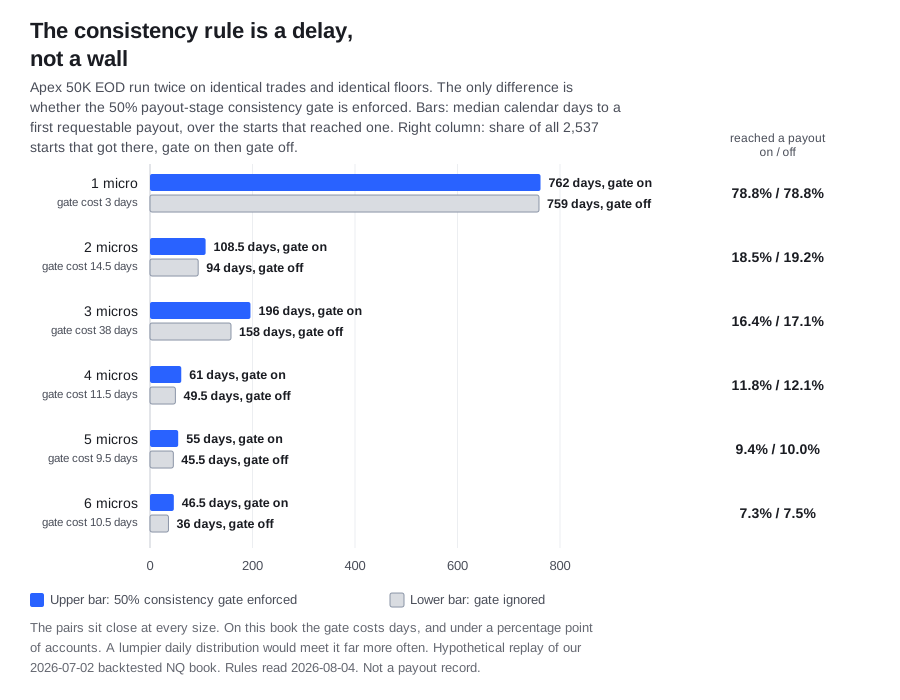
The gate is not a wall for this book. It is a delay: three days at one micro, 38 days at three micros, plus a fraction of a percent of accounts that never clear it. Small, but it is a cost with no counterpart anywhere in the evaluation rules. No amount of studying the evaluation would have revealed it.
It is close to binding, which is why it bites at all. Across the starts that did reach a payout at one micro, the median largest-day share of profit in the payout window was 34.5% and the 90th percentile was 48.1%. The ceiling is 50%.
That margin is a property of a book whose profit is spread over hundreds of days rather than a handful of windfalls. A lumpier book meets the wall far more often. We worked through why a fat-tailed record and a short cap are structurally opposed in the consistency rule and fat tails.
The first payout is capped, and the cap is not the account size
The last thing the evaluation does not tell you is how much comes out.
Apex publishes a withdrawal ladder, not a balance. On the 50K EOD account the maximum for payouts one through six is $1,500, $1,500, $2,000, $2,500, $2,500, $3,000. The minimum is $500 per request, and after the sixth payout the account is closed. The Intraday ladder differs at steps two and three.
Topstep caps a 50K XFA payout at 50% of balance, up to $2,000 on the Standard path and $3,000 on the Consistency path. That cap is the same on the first request and every later one. Take Profit Trader publishes no cap and takes 20%.
None of that appears on an evaluation page. A trader who has memorised the $3,000 profit target has memorised the wrong number. The first payout on an Apex 50K is bounded at $1,500 no matter how well the account is doing.
The profit target is not the number to memorise. Four others decide whether money comes out, and which one binds first depends on your own daily P&L. That is the question in the fastest route to a first payout.
What to check before you buy an evaluation
Four questions, all answerable from the firm's own published pages in under an hour.
One: what is the buffer, and does profit below it belong to me? At Apex and Take Profit Trader the answer is no. On a 50K, roughly the first $2,000 of profit is not yours to withdraw; it is the floor you are required to maintain.
Two: what is a qualifying day worth in dollars? Not "how many days," how many dollars per day. Then look at your own daily P&L distribution and count how many of your profitable days would clear it. If most of them do not, the day requirement is far longer than the number printed.
Three: which rules appear only at the payout stage? Read the evaluation parameter table and the payout page side by side and diff them. Apex's consistency rule is in one and explicitly absent from the other.
Four: what is the maximum first payout? Not the account size, not the profit target. The first row of the ladder.
The limits of this analysis
Every rule here was read on the firm's own live page on the date stamped beside it, and the source pages are linked at the end. Prop firms change rules without notice. Apex re-ruled its entire product line on 1 March 2026, and one current Apex help page still carries the retired Legacy payout wording alongside the current rules. Re-read the rule yourself before acting on it. We are not affiliated with any prop firm.
On our side: the replay is a hypothetical what-if on a real 15-year TradingView export. An automated reconciliation check refuses to run if the parse does not reproduce 3,500 trades and $1,112,232.40 net.
A day is an exit day, and its net is the sum of that day's closed trades. That is the right basis for rules stated on daily net P&L, but it assumes no position sits across the daily boundary. The intraday floor is reconstructed from each trade's own favorable and adverse excursion, which is exact for a book that holds one position at a time.
Payout processing time is excluded. Apex states most users receive funds within 5 to 11 business days, and Topstep's internal approval alone is 1 to 3 business days.
Topstep is deliberately not simulated here. Topstep flattens all positions at 3:10 PM CT, which is 4:10 PM ET. Our book's end-of-day exit is 4:45 PM ET, and 57.9% of its trades are not closed before that deadline.
Pricing a Topstep run would need an intraday mark-to-market at 4:10 PM ET that the trade export does not contain. So we report Topstep's published requirements and decline to model its outcome. Anyone who gives you that number without intraday data invented it. That deadline, and the session rules that decide whether a strategy is allowed to run at all, are the subject of not every strategy is eligible for every account.
None of this needed a forecast. It needed published rules and a trade record complete enough to replay against them, day by day, for fifteen years. That is why we can say the consistency gate cost this book three days at one micro instead of guessing. It is also why the withdrawal rulebook stays invisible: without a full record of your own daily P&L, there is nothing to test the rules against until they bite.
Where these rules came from
Every firm rule above was read in a browser, on the firm's own live page, on the date stamped beside it. No search snippets, no cached pages, no third-party comparison sites: prop firms retire rules faster than the rest of the web catches up, and a retired rule reads exactly like a current one. The pages this article works from:
- Apex: EOD payouts, intraday payouts, payout method information, EOD evaluations
- Topstep: Express Funded Account parameters, payout policy, trading hours and products, consistency at Topstep
- Take Profit Trader: PRO withdrawals and the buffer, PRO account rules, Rule 5, be consistent
Any of these can change tomorrow with no announcement. Read the page yourself before you pay, and if it now says something other than what is quoted here, the firm's page wins.
Rules we could NOT verify, and therefore did not state
| Firm | Item | Status |
|---|---|---|
| Take Profit Trader | Whether any minimum-days requirement exists before a first payout | UNVERIFIED. No affirmative statement on any live page. The requirement appears genuinely absent, but absence is not a quotable rule. The simulation treats it as zero, which is a modelling choice, not a claim |
| Take Profit Trader | Whether any consistency rule applies at payout | UNVERIFIED. "Be Consistent" is Rule 5 of the Test ruleset only, is not among the six PRO Account Rules, and does not appear in the Universal Trading Policies. Well-evidenced absence across three live pages, but no page affirmatively says there is none |
| Take Profit Trader | Maximum withdrawal, and any minimum interval between payouts | UNVERIFIED. No cap and no cadence stated. Fee tiers are verified: over $250 free, $250 or less incurs a $50 fee |
| Apex | The requirement for the SECOND and later payouts | CONFLICTING and live today. The product payout pages say 5 qualifying days at $250 or $200 counted since the last payout. /help-center/additional-helpful-items/payout-method-information/ says a minimum of eight days including at least five days with profits of $50 or more. Page B is the retired Legacy rule sitting un-updated on a current page. This article deliberately covers the FIRST payout only, where the two agree |
| Apex | Whether the 50% consistency figure governs Legacy accounts | UNVERIFIED. A separate Apex page states Legacy accounts retain a 30% rule. Nothing here describes the Legacy product |
| Topstep | Whether an overnight Globex hold is permitted | CONFLICTING on Topstep's own page. The hours table permits it, the FAQ on the same page answers "No." Not load-bearing here |
Every trade behind these numbers is on the tear sheet, the strategies are on our strategies page, and the signals are what we sell.
Disclosure. We trade this book live and sell access to the signals, so judge the data accordingly. This article is educational and is not investment advice, a recommendation, or an offer to buy or sell any security or futures contract, and it is not a recommendation of any prop firm, account type, or position size. Nothing here is a projection of income. We have no affiliation with Topstep, Apex Trader Funding, Take Profit Trader, or any prop firm. Every rule cited was read on the firm's own live page on the date shown and can change at any time.