Can I follow trade signals on my Apex, Topstep or Take Profit Trader (TPT) accounts?
Short answer. None of the three firms gives a clear yes, so ask in writing first. Take Profit Trader has the clearest written rule: you may follow signals by hand if each decision is your own, but it monitors for trades timed and sized like other users'. Apex has no rule on signal services, but its rewards are "not to reward automated systems executing preprogrammed logic", and Topstep prohibits trading "the same or opposite strategy simultaneously" with third parties. For a follower of our NQ book, size and news bind too: in our hypothetical backtest, one NQ mini per signal hit a 50K evaluation's loss limit first from 65.6% of 2,530 historical start dates, and the book held a position through 93 of 466 jobs-report, CPI and FOMC releases.
A firm can allow signals and still fail the account that follows them. This guide quotes each firm's rule, tests our own book against the limits that end prop accounts (the loss limit, news blackouts, the daily close), then gives a verdict per firm and a checklist.
An evaluation is the paid test you pass before a firm funds you. On a 50K evaluation you need $3,000 of profit before your balance touches the loss limit, which starts $2,000 below your starting balance.
Do Apex, Topstep and Take Profit Trader allow you to follow signals by hand?
Not clearly at any of them. Take Profit Trader names manual following but requires each decision to be your own; Apex's automation rule and Topstep's coordinated-trading clause may each cover it. Ask each firm in writing.
| Rule as published, checked October 5, 2026 | Topstep | Apex | Take Profit Trader |
|---|---|---|---|
| You place the signal's trades by hand | Not named. Prohibits "coordinated trading", including trading "the same or opposite strategy simultaneously" with "unconnected accounts or third parties" | Not named. No rule on signal services; its automation rule may reach a person placing an algorithm's trades | Permitted on conditions: "Traders may manually follow or learn from other traders", but decisions and executions "must be independently made" |
| Copier across your own accounts | Yes in the Combine and Express Funded Account (XFA). On the Live Funded Account its pages conflict: TopstepX says its copier is unavailable, the Live Funded Account page says you can use one | Yes: Apex documents Tradovate's Group Trade copier for your own accounts | Yes, approved copiers only |
| Copier linked to another person | Prohibited | "trade copying with other traders is strictly forbidden" | Prohibited |
| Bots and automated execution | "Yes, with conditions" in the Combine and XFA; not possible on the Live Funded Account | "No Automation or Algorithm Usage allowed" | "No Trading Bots or Algos", on Test, PRO and PRO+ |
These clauses matter because every subscriber receives the same entry at the same moment. Take Profit Trader requires each account to make "discretionary trading and execution decisions", and its surveillance watches "trade timing correlation", "strategy similarity" and "risk and position sizing patterns". Taking every signal at a fixed size matches what it monitors. If it finds coordinated trading it can forfeit profits, reset or liquidate the account, even after a payout review.
Apex says its rewards are for human traders, "not to reward automated systems executing preprogrammed logic." Our alerts describe each signal as an automated signal from our model, so a person placing those trades may fall inside that rule.
How much size can a follower use on a 50K evaluation?
Much less than one NQ mini per signal, and the smaller size costs time. In our hypothetical replay, one mini hit the $2,000 loss limit before the $3,000 target from 65.6% of 2,530 start dates; two micros (MNQ, a tenth of a mini each), at Topstep's $1.22 per micro, cut that to 37.4%, but the start dates that passed took a median (middle) 255.5 calendar days.
The replay works in four steps:
- Treat every trading day in our record, 2011 to 2026, as a day you bought a 50K evaluation: 2,532 start dates.
- From each start date, take every signal at one fixed size. Each micro pays its firm's published round-trip cost: Topstep $1.22, Apex $1.04, Take Profit Trader $1.50. Rows not tied to one firm use Topstep's $1.22.
- After each close, move the loss limit up to $2,000 below the highest closing balance, until it reaches the starting balance.
- Stop at a pass ($3,000 of profit) or a bust (an open loss touches the limit).
A pass rate here is the share of historical start dates that passed, not your chance of passing. The replay uses backtest fills; a follower acting on alerts fills later, and usually worse.
That is the Topstep Combine and Take Profit Trader Test. Apex adds a 30-calendar-day limit and a session pause at a $1,000 daily loss, and its floor keeps rising past the starting balance. There two micros passed from only 9.6% of start dates, at its $1.04 per micro. Small sizes pass slowly: with no time limit and Topstep's $1.22, the two-micro start dates that passed took a median of nine 30-day periods (one micro: 28). On a monthly-billed evaluation, count the busts too, since they paid until they busted: on the same basis the median run lasted 11 billing periods at two micros and 19 at one micro, and two-micro busts paid a median 15.
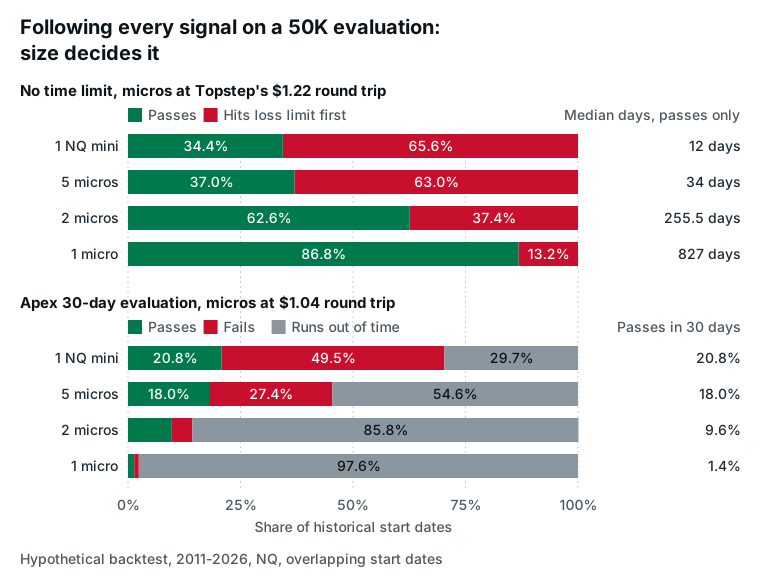
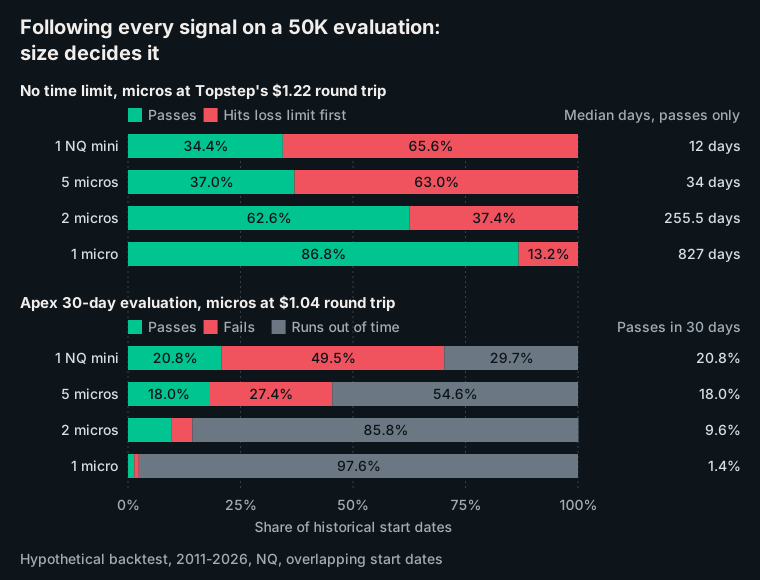
| Size per signal | Busts, no consistency rule ($1.22) | Passes, Topstep 55% rule ($1.22) | Passes, Topstep 55% rule and 4:10 PM flatten ($1.22) | Passes, Take Profit Trader 50% rule ($1.50) | Median calendar days to pass, passes only ($1.22) | Apex 30 days ($1.04): passes / fails / out of time |
|---|---|---|---|---|---|---|
| 1 NQ mini | 65.6% | 29.9% | 28.8% | 28.9% | 12 | 20.8% / 49.5% / 29.7% |
| 5 micros (half a mini) | 63.0% | 35.4% | 32.1% | 32.2% | 34 | 18.0% / 27.4% / 54.6% |
| 2 micros | 37.4% | 62.3% | 53.3% | 61.3% | 255.5 | 9.6% / 4.7% / 85.8% |
| 1 micro | 13.2% | 86.7% | 80.0% | 86.0% | 827 | 1.4% / 1.0% / 97.6% |
Shares of historical start dates that finished before the data ends, 2,503 to 2,532 per column. Median days count only start dates that passed, with no consistency rule. Each heading gives that column's cost per micro round trip; one mini pays our own commission everywhere. Topstep's 55% rule is measured against the $3,000 target: a best day above $1,650 raises the target. Hypothetical backtest.
A consistency rule caps the share of profit your best day may supply. Take Profit Trader's 50% rule cut the one-mini pass rate from 34.4% to 28.9%; when it binds you trade on, so the median one-mini pass took 26.5 calendar days instead of 12. More in the consistency rule vs fat-tailed systems.
Topstep's 4:10 PM ET flatten, on top of its 55% rule, raised the two-micro bust rate from 37.7% to 46.7%, mostly through 2016 to 2020 starts; for 2021 to 2025 starts it moved only from 19.8% to 18.6%.
Pooled rates hide clusters. At one micro every 2019 start busted, 18.1% of 2022 starts busted, and every 2021, 2023, 2024 and 2025 start passed. All its busts fall in March 2020, May 2022 and July 2026, our first live month (our first 30 days of live signals has the live trades; the replay uses backtest ones). An 827-day median pass leaves fewer than seven non-overlapping windows in 15 years.
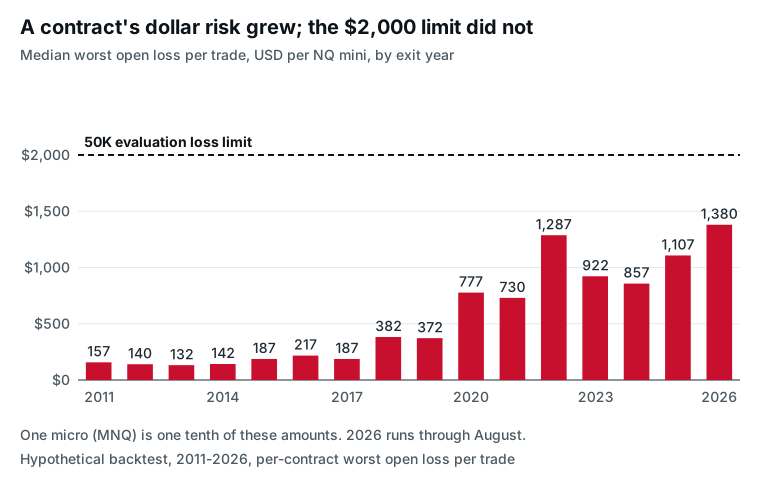
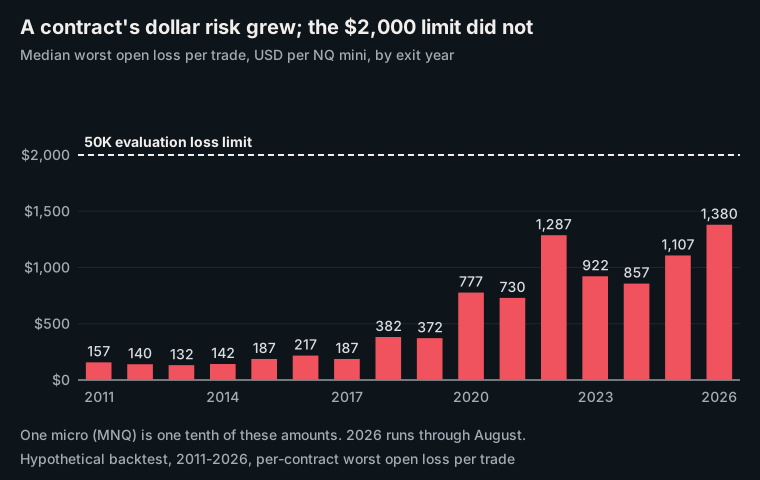
A contract also carries far more dollar risk than it did. The median trade's worst open loss, the deepest it went against you before closing, was $142 per NQ mini in 2014 and $1,380 in 2026 through August, against the $2,000 limit.
At micro size, cost matters as much as the calendar. From 2011 to 2015 the average trade earned at most $2.12 per micro before commission, so $1.22 took most or all of it. At two micros and $1.22, 45.7% of 2011 to 2020 start dates busted, 19.8% of 2021 to 2025 and 39.6% of 2026's 91, against 37.4% pooled. Recent years are not safer: 2015 to 2020 starts busted 17.0%. The early years fail on cost: at a tenth of our mini commission, 2011 to 2014 starts busted 6.2%, not 96.2%, while 2021 to 2025 barely moved (19.2% to 19.8%). The bust rate swings a lot with cost, so your own commission matters: the same replay busts 22.3% of start dates at $1.04 and 18.0% at $0.74. For sizing outside a prop firm, see who STS is not for.
Does the book trade through the news releases the firms restrict?
Yes. In our hypothetical backtest our NQ book held a position through 93 of 466 jobs-report, CPI and FOMC releases on trading days, about 6.2 a year, and that is the likeliest rule breach for a follower at Take Profit Trader.
- Take Profit Trader: every PRO account must hold no position and no open order from one minute before to one minute after FOMC statements (Wednesdays, 2:00 PM ET), the jobs report (NFP, Fridays, 8:30 AM ET) and CPI. PRO also requires at least one traded day each calendar week. Our book takes no new entries in the quarterly roll week (the week containing the second Thursday of March, June, September and December); 43 of 60 roll weeks in the backtest had no signal, so a follower who trades only our signals would break that rule in most of them (how often our NQ signals fire).
- Topstep: "doesn't require you to flatten positions during economic releases" but prohibits trading your full Maximum Position Size into a scheduled major release.
- Apex: allows trading during news "for your normal trading strategy".
| Release, August 2011 to August 2026 | Releases on trading days | Our book held a position (hypothetical backtest) | Per year |
|---|---|---|---|
| Jobs report (NFP), 8:30 AM ET | 170 | 34 | 2.3 |
| CPI, 8:30 AM ET | 177 | 31 | 2.1 |
| FOMC statement | 119 | 28 | 1.9 |
| Total | 466 | 93 | 6.2 |
Eight jobs reports and two CPI releases fell on exchange holidays and are excluded.
Every jobs-report and CPI collision was an Overnight-strategy trade (evening entry, next-morning exit); 687 of its 793 trades were still open at 8:30 AM ET. A PRO follower must exit those trades early (checklist step 8), and we have not measured what that costs. How the book did on release days is in how our NQ strategy did on FOMC, CPI and jobs-report days.
Do the firms' daily close times cut the signals short?
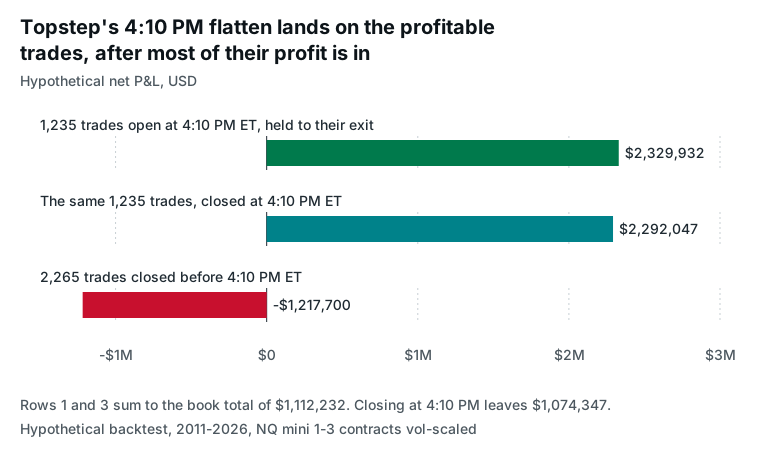
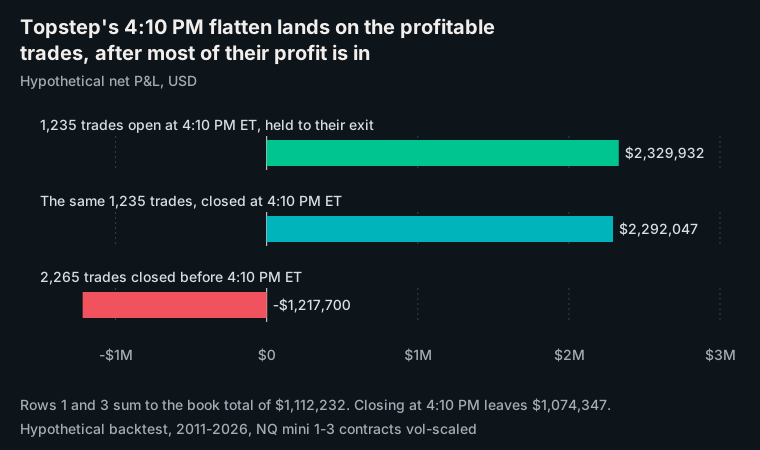
Only Topstep's close cuts them short: its 4:10 PM ET flatten closes 35.3% of our hypothetical trades early, costing 3.4% of the book's net profit and more in evaluation passes (verdict table below). Apart from 19 weekend holds in 2011 and 2012, every trade closed before Apex's and Take Profit Trader's deadlines.
Our Overnight trades stay inside one trading day, because all three firms start the day at 6:00 PM ET (Topstep: 5:00 PM CT); Topstep's ban on holding overnight means holding "from one session to the next". The 19 weekend holds, all between September 16, 2011 and November 9, 2012, would breach all three firms' rules.
The 1,235 hypothetical trades still open at Topstep's flatten (3:10 PM CT) carry the book's profit, $2,329,932 against a $1,217,700 loss on the other 2,265, but by 4:10 PM they had earned almost all of it. Closing each at its 4:10 PM price removes $37,885, 3.4% of the book's $1,112,232 net.
Which prop firm fits a signal follower?
None, without a written answer first. Take Profit Trader has the clearest written rule and the strictest news rule. Apex fits the hours, but its 30-day clock leaves little room at micro size. Topstep's daily flatten costs the book little in dollars and a lot in evaluation passes.
| Firm, rules checked October 5, 2026 | Following by hand | 50K evaluation, hypothetical replay | News | Daily close | Verdict |
|---|---|---|---|---|---|
| Take Profit Trader | Named, on conditions: each decision your own. It monitors timing, strategy similarity and sizing patterns, which taking every signal at one size matches; the penalty can be profit forfeiture. No bots, no copier to another person | One mini passes 28.9% under its 50% rule; two micros 61.3% at its $1.50 per micro | PRO: flat one minute either side of NFP, CPI and FOMC; one traded day every week | 4:55 PM ET auto-close; no clash since November 2012 | Clearest written rule; still ask in writing |
| Apex | No rule names signal services; its automation rule may reach a person placing an algorithm's trades. No copying with other traders | 30 days to pass: one mini 20.8%, two micros 9.6% at its $1.04 per micro | Allowed "for your normal trading strategy" | 4:59 PM ET; no clash since November 2012 | Only after a written yes from support; the 30-day clock squeezes every size |
| Topstep | Not named; its coordinated-trading clause may cover it | 55% rule and 4:10 PM flatten: one mini 28.8%, two micros 53.3% at its $1.22 per micro | No full Maximum Position Size into a major release | 4:10 PM ET flatten closes 35.3% of trades early, 3.4% of net; two-micro bust rate rises from 37.7% to 46.7% | Only after a written yes from support |
After you pass, the limit does not grow with you. At Topstep and Apex the funded 50K account keeps a $2,000 loss limit, and Take Profit Trader's PRO limit trails intraday on open profit. So a pass at two micros leaves a funded account whose limit sits below the book's typical drawdown at micro size: across 10,000 reshuffles of our trades at 1 to 3 MNQ, the median drawdown was $4,538 and the 1-in-20 case $6,784. Both scale our book to a tenth, so they carry a tenth of our mini commission ($0.41 per micro), not a firm's micro cost; at that cost they would be deeper. STS publishes $16,000, 3.5 times that median, as the account size its record supports at micro size.
Take Profit Trader's PRO+ funding also reviews traders whose activity is "mostly aggressively sized positions at fixed, predictable market moments like the open". In our backtest 45.6% of 3,500 signals arrived in the opening half hour, 9:30 to 10 AM ET, so a follower's record will show that pattern. Apex applies a 50% consistency rule at payout.
Sources: Topstep prohibited conduct, TopstepX, trading hours, consistency, maximum loss limit, commissions and fees. Apex prohibited activities, trading times, EOD evaluations, EOD drawdown explained, Rithmic commissions, Tradovate commissions. Take Profit Trader independent execution, trading policies, PRO rules, consistency, EOD drawdown, Sustainable Trading Policy, commissions.
STS is not affiliated with or endorsed by Topstep, Apex or Take Profit Trader.
What does this mean for you?
No firm has said yes in writing to a signal follower, so get that answer from support before you pay. After that, size, news timing and the funded limit decide whether a follower keeps the account.
How to follow signals on a funded account
- Read the firm's prohibited-conduct page before you buy an evaluation.
- Ask support in writing whether you may place a signal service's trades by hand. Quote the rule that may cover it: Topstep's coordinated-trading clause, Apex's automation rule, Take Profit Trader's independent-execution policy. Keep the reply.
- Place every order yourself. Our signals arrive by email, on the web dashboard and through a live feed, and place no trades.
- Use no copier linked to another person, and no bot at Apex or Take Profit Trader.
- Pick your size first. In our hypothetical replay, one NQ mini per signal busted from 65.6% of start dates and two micros, at $1.22 per micro, from 37.4%.
- Check that size against the time limit and the monthly fee. Inside Apex's 30 days, two micros passed from 9.6% of start dates; with no limit, the start dates that passed took a median 255.5 days.
- Mark every jobs-report, CPI and FOMC release; Take Profit Trader's trader calendar lists the ones it enforces.
- On a Take Profit Trader PRO account, close any position before 8:29 AM ET on jobs-report and CPI mornings, be flat from one minute before to one minute after each FOMC statement, and trade at least one day every calendar week, which in most roll weeks means a trade of your own.
- At Topstep, never hold your full Maximum Position Size into a major release, and expect the 4:10 PM ET flatten to close 35.3% of our trades early.
- Before you fund, compare the funded account's $2,000 limit with the book's median micro-size drawdown of $4,538, figured at $0.41 per micro.
How we measured this
Data. Our full hypothetical trade record, data as of August 5, 2026: 3,500 trades from 2011 to 2026, net $1,112,232, win rate 45.5%, NQ mini 1 to 3 contracts vol-scaled (sized by recent volatility) on a $100,000 nominal basis, after $4.10 per contract round-trip commission and two ticks of slippage on market and stop fills; limit fills carry none. All results are hypothetical backtest performance.
Replay. One NQ mini per signal is each trade's net P&L divided by its contract count. One micro is a tenth of that, paying its firm's published MNQ round-trip cost instead of a tenth of our $4.10: Topstep $1.22 ($0.50 commission, $0.70 exchange, $0.02 NFA), Apex $1.04 on Tradovate (its Rithmic $1.02 gives the same two-micro result), Take Profit Trader $1.50. A trade busts the run if the balance before it plus its worst open loss reaches the loss limit. Fills are the backtest's.
Timing. Times are fill times, Eastern. A news collision is a position open inside one minute either side of a dated BLS or Federal Reserve release.
4:10 PM prices. Topstep's 4:10 PM prices come from an independent NQ price record that matches 97.3% of our entry fills within one point; each affected trade keeps its entry, commission and slippage and gives up the market's move from 4:10 PM to its exit. 93 of the 1,235 trades, 87 of them between June 2025 and July 2026, fall in gaps in that record and keep their actual exit; at the same rate they would remove about $6,209 more.
Excluded. The Take Profit Trader and Apex replays keep the 2011 to 2012 weekend holds. The Apex replay treats the daily loss limit as a flatten at a $1,000 loss and starts its 30 days at the first signal day. Funded stages, payout rules and Topstep's optional daily loss limit are not modelled. Late starts count only if they finish quickly, which inflates 2026's bust rate.
Hypothetical Performance Disclaimer (CFTC Rule 4.41): These results are based on simulated or hypothetical performance results that have certain inherent limitations. Unlike the results shown in an actual performance record, these results do not represent actual trading. Also, because these trades have not actually been executed, these results may have under- or over-compensated for the impact, if any, of certain market factors, such as lack of liquidity. Simulated or hypothetical trading programs in general are also subject to the fact that they are designed with the benefit of hindsight. No representation is being made that any account will or is likely to achieve profits or losses similar to these being shown.
Past performance is not necessarily indicative of future results. Futures trading involves substantial risk of loss and is not suitable for all investors.
See what STS NQ futures signals are and how they reach you and our forward record, every live signal we have sent, dated and public.