The no-card free trial standard: what 7 days of NQ signals can and cannot prove
Most "free trial" offers in the signals world are built to do one thing: charge your card on day 8 before you remember you signed up. We took the card out of the equation. Our free 7-day trial asks for an email, nothing more. There is no payment method on file, so there is nothing to forget and nothing to cancel. When the week ends, it simply ends.
That policy raises a fair question. If we are not using the week to lock you into a payment, what is the week actually for? The honest answer is narrow, and we would rather say it plainly than let you draw the wrong conclusion. In short: the week can prove that our signals are real and delivered on time, and that we show our whole record. It cannot prove the edge itself, because seven days is far too small a sample to judge a system that took thousands of trades to establish. Here is why, and what to do with the week instead.
One week is a sample size of noise
Our book is a 45.5% win-rate system. That number is not a weakness, it is the design. The edge comes from the payoff ratio: the average winning trade returned $1,937 against an average loss of $1,033, a payoff of 1.88 to 1. A system like that wins less than half its trades by construction, and it strings losses together. Over the 15-year backtest, the worst losing streak was 14 trades in a row.
Sit with that for a second. If 14 consecutive losses can happen inside a validated record, then any single 7-day window can land anywhere: green, red, or flat, and none of those outcomes tells you whether the underlying edge is real. A profitable week would not prove we are good. A losing week would not prove we are broken. Both are the expected behavior of a 45.5% system observed through a keyhole.
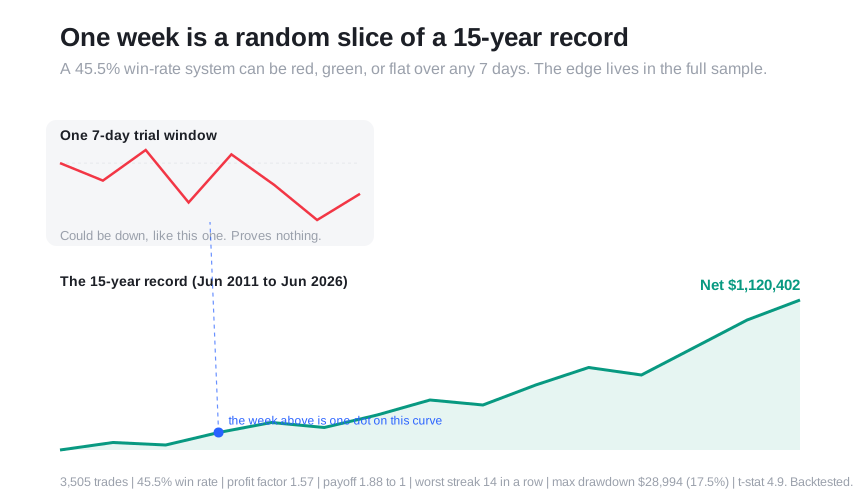
The statistical weight of our claim lives in the full sample: 3,505 trades from June 2011 to June 2026, a profit factor of 1.57, and a t-stat of 4.9 across the record. Seven days holds a handful of trades. You cannot compress a 15-year distribution into a week, and we will not pretend otherwise. If you want to understand why even a losing month is normal for this profile, read our note on how long drawdowns actually last.
So what does the trial actually prove
The trial verifies the two things a week genuinely can verify.
First, that the signals are real and arrive on time. During the trial you receive our live alerts by email and on your dashboard, the same entries and exits our system fires in real time. You get to watch the machine work: when it calls a trade, how promptly the alert lands, and whether what we describe matches what shows up in your inbox. That is a delivery test, and a week is plenty of time to run it. You can start the free 7-day trial with no card and run that test yourself this week.
Second, that we show our whole record, not a curated slice. Alongside the live alerts you get the full history: every trade, the drawdowns included, the losing streaks included. We do not hide the 17.5% peak-to-trough drawdown ($28,994 at its worst) or the fact that more than half of our individual trades lose. You can inspect the complete tear sheet and audit it against the alerts you are receiving in real time. If the two agree, you have learned something real about how we operate.
What the trial deliberately does not include is the TradingView script. The trial is alerts-only. The invite-only script, the 5-strategy engine that auto-plots entries and exits on your own chart, comes with Full Access. We keep it behind the paywall because the script is the tool you trade with, and the free week is meant to prove trust, not hand over the engine.
Whose trades are these
The record is our own book. It is a single-position portfolio of five NQ strategies traded as one combined system, sized at 1 to 3 volatility-scaled NQ mini contracts, with costs included and no compounding. The results above are backtested over the 15-year window. We publish them because they are the same signals the trial delivers live, and because we think you deserve to see the losing streaks before you ever consider paying us.
One limitation we will state directly: a backtest is a hypothetical reconstruction, and live markets add slippage, fills, and human execution that a model does not fully capture. Your results, if you ever act on the signals, depend on your own execution and can differ from the record. We never touch your account and never place a trade for you. Execution always stays with you. There are no done-for-you profits here, only signals you choose to act on or ignore. For the discipline of checking any vendor's numbers yourself, see how to audit a trading track record.
The conflict, stated plainly
We trade this book live and we sell access to the signals. That is a conflict of interest, and you should weigh it. Our defense against it is the only one that holds up: we show the full record, drawdowns and losing streaks included, and we let you verify the live alerts against that record during a week that costs you nothing and takes no card. If the numbers did not survive scrutiny, radical transparency would be a terrible business model. We are betting it is a good one. If you are still deciding whether any signal service earns its fee, we wrote a separate piece on whether futures trading signals are worth it.
What happens when the week ends
Nothing automatic, and nothing punitive. Because we never collected a card, there is no charge on day 8. Your access to the alerts simply pauses. If the delivery held up and the record checked out to your satisfaction, you can move to Full Access at $300 per quarter or $1,000 per year, which adds the TradingView script and is itself cancelable anytime. If the week did not convince you, you walk away having risked nothing but an email address. That is the entire point of removing the card.
A last piece of honesty before you decide. Expect your first real drawdown to feel worse than the backtest reads on paper, because you will be living through it in real time rather than scrolling past it in a chart. We wrote about that gap in why you should expect a worse drawdown than the backtest. Go in knowing that, and a red week will not surprise you into quitting a system that was behaving exactly as designed.
The week is not a demo of a good month. It is a demo of whether we are who we say we are, at zero cost and zero commitment, which is the one thing a week can actually settle before you decide anything larger.
Conflict disclosure: we trade this book live and sell access to the signals. Judge the data on its merits.
CFTC Rule 4.41: Hypothetical or simulated performance results have certain inherent limitations. Unlike an actual performance record, simulated results do not represent actual trading. Also, since the trades have not actually been executed, the results may have under- or over-compensated for the impact, if any, of certain market factors, such as lack of liquidity. Simulated trading programs in general are also subject to the fact that they are designed with the benefit of hindsight. No representation is being made that any account will or is likely to achieve profit or losses similar to those shown.
Past performance is not necessarily indicative of future results. Futures trading involves substantial risk of loss and is not suitable for every investor.