Overnight NQ Signals You Can Take After Work: STS's Evening Entry, Out Before 9 a.m. ET
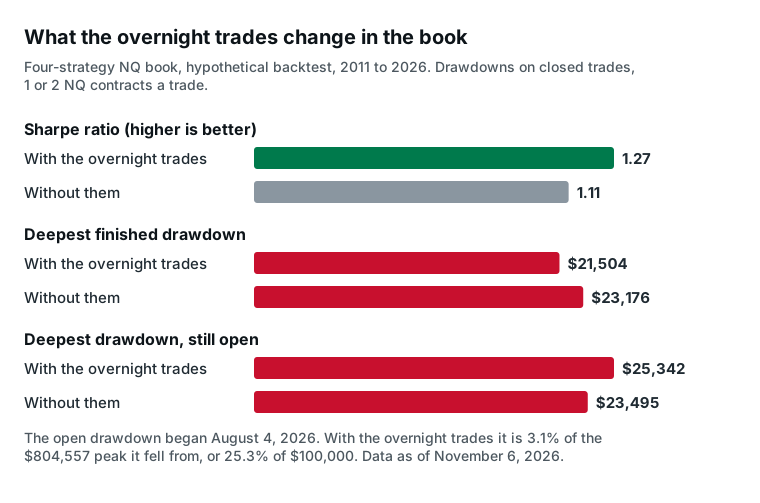
Short answer. STS's Overnight strategy sends its entry alert between 6:20 and 6:30 p.m. ET, and in our hypothetical backtest all 808 of its trades were closed before 9 a.m. ET. Those trades produced 16.2% of our four-strategy book's hypothetical net profit and lifted its Sharpe ratio from 1.11 to 1.27.
When do the overnight alerts arrive?
The entry arrives between 6:20 and 6:30 p.m. ET, Sunday to Thursday. Most exits arrive in the 8 a.m. hour, before the 9:30 a.m. stock market open.
In our backtest, 706 of the 808 overnight trades (87.4%) closed in the 8 a.m. hour, the other 102 earlier in the night, and none after 9 a.m.
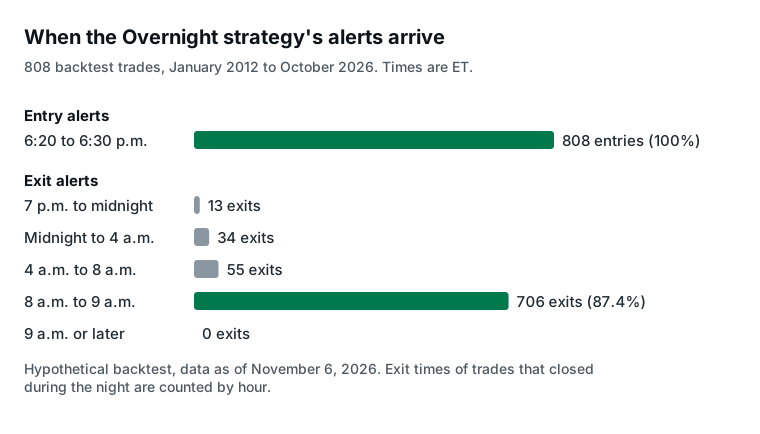
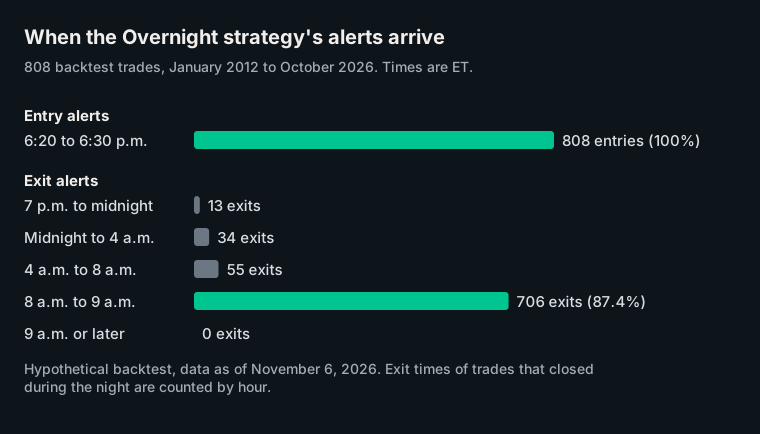
Overnight is the only one of our four strategies that enters after the 4 p.m. ET close, so an entry alert in that evening window is always this strategy. The best time to trade NQ futures shows when the other three fire.
What does a weeknight with the Overnight strategy look like?
Two short tasks: one in the evening, one before work. Each alert tells you what to do, and you place the order yourself on your own platform.
The entry alert gives the direction, contract count, price and time in ET; the exit alert adds the entry and exit prices and how long the trade lasted. Every overnight trade in the backtest was a long position.
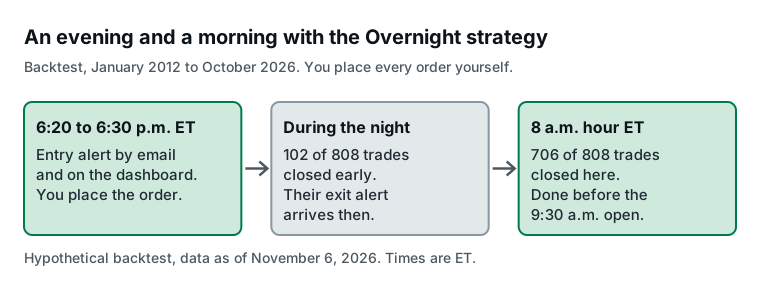
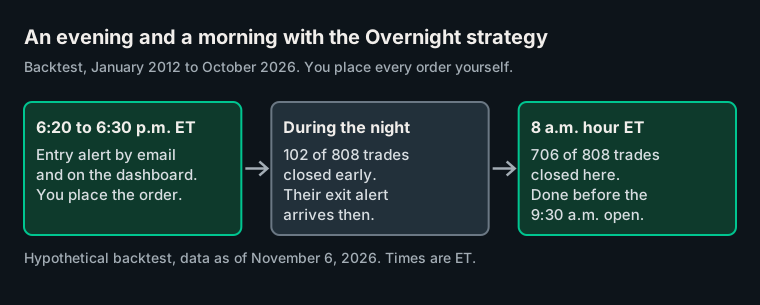
Most trades, 84.0%, close at the planned morning exit. The other 16.0% close earlier at a stop or a target, and some of those land while you sleep.
We tested what sleeping through them costs, with 1-minute prices from June 2020 to May 2025. A trader asleep from 11 p.m. to 7 a.m. who closed those trades at the morning exit instead kept 101.4% of the strategy's hypothetical profit in that window. Only 10 of its 172 trades changed, so read that as no cost rather than a gain.
Early exits that arrive while you are awake still count: skipping every early exit, awake or asleep, kept 73.6%. Set your phone to show alerts in the evening and before work.
Are the evening trades worth taking?
In our backtest, on balance yes: they produced 16.2% of the book's hypothetical net profit from 25.7% of its 3,139 trades and lifted its Sharpe ratio from 1.11 to 1.27, though the deepest drawdown, still open, is deeper with them.
The Sharpe ratio is the book's return per unit of day-to-day volatility, on our published basis. With the overnight trades, 114 of the backtest's 181 months were profitable; without them, 109.
Drawdowns, the falls from a previous high, move both ways. The deepest drawdown that has finished, ending at a new high, is shallower with the overnight trades: $21,504 against $23,176. The deepest drawdown in the backtest, which began on August 4, 2026 and was still open on November 6, 2026, is deeper with them: $25,342 against $23,495 on closed trades. With them, it is 3.1% of the $804,557 peak it fell from, or 25.3% of a fixed $100,000 account.
For the strategy's own statistics, see our overnight strategy backtest.
How often does the evening strategy fire?
About once a week on average, in uneven bursts. From January 2012 to October 2026 it averaged 1.05 trades a week, and 40.1% of weeks had at least one.
Long quiet stretches happen: none from December 2021 to early May 2023, and none from February to mid-September 2026. For how often the whole book fires, see how often NQ signals fire.
How we measured this
Our four-strategy NQ book holds one position at a time and trades the NQ mini, 1 or 2 contracts a trade (2 when daily ranges are small, 1 when they are large; every trade since July 2024 has been 1 contract). Every figure comes from its TradingView backtest, 2011 to 2026 (data as of November 6, 2026): 3,139 trades, commissions and slippage included. The strategies are momentum and trend-following, not mean reversion, so these figures describe our system, not a rule about the overnight session. All results are hypothetical.
Alert times are the close of the five-minute bar that fired the signal, in ET. Checked against 1-minute CME NQ prices from June 2020 to May 2025, 97.7% of overnight entry prices matched within half a point. The sleep test moves each early exit to the same trade's morning exit, with the same half-point slippage.
The Sharpe ratio uses daily returns over all 3,908 weekdays, with days without a trade counted as zero and a running-equity denominator, annualised by the square root of 252. The few trades that closed on a Sunday night fall outside that weekday series; counting them on the Monday instead gives 1.30 with the overnight trades and 1.16 without. Had removing them raised the Sharpe ratio, they would not be earning their place.
What this means for you
If your workday runs from about 9 to 5 ET, the Overnight strategy fits around it: place the entry in the evening and close it before work, with your phone set to show the occasional early exit. You still receive every alert from all four strategies, listed on our strategies page, and you choose which to take. Membership is $50 a month or $500 a year, and you can cancel anytime; see pricing.
We trade this book live and sell access to the signals, so judge the data accordingly. This article is educational and is not investment advice. Futures trading involves substantial risk of loss and is not suitable for every investor.
Hypothetical Performance Disclaimer (CFTC Rule 4.41): These results are based on simulated or hypothetical performance results that have certain inherent limitations. Unlike the results shown in an actual performance record, these results do not represent actual trading. Also, because these trades have not actually been executed, these results may have under- or over-compensated for the impact, if any, of certain market factors, such as lack of liquidity. Simulated or hypothetical trading programs in general are also subject to the fact that they are designed with the benefit of hindsight. No representation is being made that any account will or is likely to achieve profits or losses similar to these being shown.
Past performance is not necessarily indicative of future results. Futures trading involves substantial risk of loss and is not suitable for all investors.
See what STS NQ futures signals are and how they reach you and our forward record, every live signal we have sent, dated and public.