Auto trading NQ futures with a TradingView script: what actually gets automated, and what never is
Search "auto trade NQ futures" and you get a wall of tools promising a hands-off account that prints money while you sleep. We are going to be the boring, honest entry in that list. Our TradingView script does automate something real, but it is not your order and it is not your money. This page draws the line exactly, because in this query family the line is where most of the scams live.
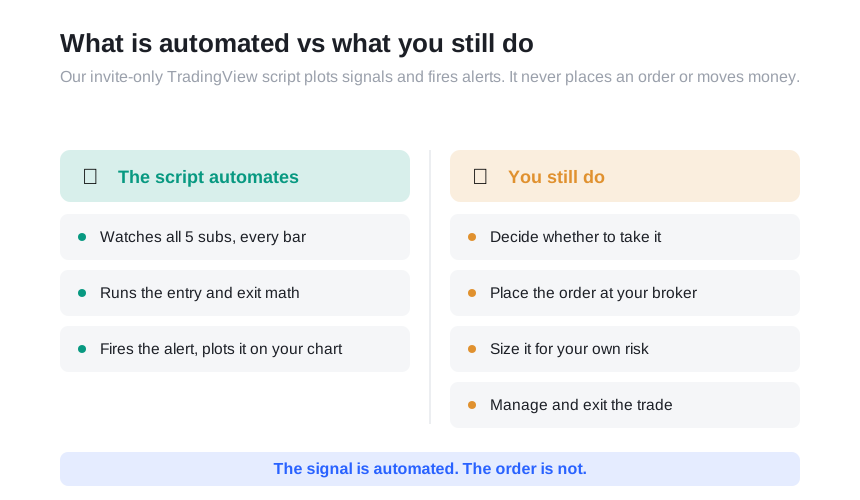
The short version: our script automates the watching, the math, and the alert. You still decide to take the trade, place the order with your own broker, size it for your own risk, and manage it. "Automated" here means the analysis and the signal are automated. The execution never is.
What the engine actually is
Full Access includes our invite-only TradingView script, which is the live 5-strategy engine that runs our book. Five systematic sub-strategies share one single-position account. Each sub watches a different slice of the day: an early-session play, an opening-range play, a short setup, an overnight hold, and an intraday trend follower. A sixth sub has been retired. Because the five share one position, the engine is not firing five separate trades at once. It resolves them into a single net stance and shows you that one position.
The subs are close to independent. Across the five, the average pairwise correlation is 0.11, which is why combining them into one book smooths the ride rather than stacking the same bet five times over. You can see the full per-strategy breakdown on our strategies page.
What you see on your own chart
Once you have access, you add the script to your NQ chart in TradingView and it draws directly on your candles. Entries and exits appear as markers on the price where they happened. Each marker is labeled with which sub fired, so you are not staring at an anonymous arrow wondering where it came from. When the position changes, the plot changes with it, and the alert you set fires to your email or phone.
This is a different thing from a screenshot of someone else's results. The plot is live on your chart, on your data feed, updating on your bars. We wrote a separate piece on why that distinction matters in script on your chart versus screenshots, and on how the invite-only access model itself works in how invite-only TradingView scripts work.
What is automated, precisely
Three things happen without you lifting a finger. First, the watching: the script evaluates all five subs on every bar, all session, whether you are at the screen or not. Second, the math: the entry and exit logic that defines each sub is computed the same way every time, with no discretion and no mood. Third, the alert: when a sub triggers, the signal is plotted and an alert is sent.
That is the whole of the automation. It is genuinely useful, because the tedious, error-prone parts of a systematic approach are exactly the watching and the disciplined math, and a machine does those without getting tired or talking itself out of a rule.
What is never automated
The script does not connect to your broker. It does not place, modify, or cancel an order. It does not move money, and it cannot, because it has no access to your account and no authority over it. When an alert fires, nothing has been traded. You read the signal and you decide.
So the parts that carry the actual risk stay with you: whether to take the trade at all, placing the order in your own platform, choosing your contract count, setting your own stop, and managing the exit. If you are away from your desk when an alert fires, no trade happens on your behalf. That is not a limitation we are apologizing for. It is the design. Anyone selling you the opposite in this category is selling you a problem.
Whose trades are these
The signals come from our own live book. We trade this engine with real money and we sell access to the same signals. That is a conflict of interest and we would rather state it plainly than have you discover it. It also aligns us with you in one specific way: the engine you subscribe to is the engine we run, not a watered-down demo. Our whole pitch is verified, reproducible data rather than testimonials, so the numbers below are the ones we hold ourselves to.
The track record, as context not promise
Here is what the combined book did in backtest, and we mean backtest. Over June 2011 to June 2026, trading 1 to 3 volatility-scaled NQ mini contracts, costs included and with no compounding, the book produced net $1,120,402 across 3,505 trades. Win rate was 45.5%, profit factor 1.57, and the per-trade t-stat was 4.9. The worst peak-to-trough drawdown was $28,994, which was 17.5% of peak equity. On the micro contract (MNQ), the dollars scale by roughly one tenth, so about $112,040 net and about a $2,899 drawdown, at the same win rate and ratios.
Read those as context for what the engine is, not as a forecast of what your account will do. They are hypothetical, and they are not fills. A plotted signal is a price on a chart. Your real result depends on your slippage, your latency between the alert and your order, your fills, and your own management of the trade. Two subscribers taking the same alert can end a month in different places for exactly those reasons. If you want to think through whether a signal service earns its keep at all, we laid out the framework in are futures trading signals worth it, and the full portfolio report lives on the tear sheet.
Where this leaves you
If you came here wanting software that runs your NQ account hands-off, we are not that, and we will not pretend to be. What we offer is narrower and more honest: a systematic engine that does the watching and the math for you, plots its signals on your own chart, and tells you the moment one fires, while leaving the order and the risk where they belong, with you. The free 7-day trial gives you the alerts by email and dashboard with no card and no script, so you can judge the signals before the script ever touches your chart. You can compare that against Full Access on the pricing page.
Automating the analysis is a real edge. Automating away your own judgment is how people in this corner of the internet get hurt. We built the first and refused the second on purpose.
Whose data this is: the figures above come from our own TradingView strategy backtests on NQ (CME), June 2011 to June 2026, run at one to three contracts scaled by volatility, costs included, no compounding. We trade this book live and sell access to the signals, which is a conflict we disclose openly.
CFTC Rule 4.41 disclaimer: These results are based on simulated or hypothetical performance results that have certain inherent limitations. Unlike the results shown in an actual performance record, these results do not represent actual trading. Also, because these trades have not actually been executed, these results may have under- or over-compensated for the impact, if any, of certain market factors, such as lack of liquidity. Simulated or hypothetical trading programs in general are also subject to the fact that they are designed with the benefit of hindsight. No representation is being made that any account will or is likely to achieve profits or losses similar to these being shown.
Past performance is not necessarily indicative of future results. Futures trading involves substantial risk of loss and is not suitable for every investor.