TopStep vs Apex: more room, meaner floor, and which one survives the book
TopStep gives you a $2,000 trailing floor. Apex gives you $2,500. Apex is the roomier account, so the comparison looks over before it starts. It isn't. Apex's extra $500 rides on a meaner default: its intraday floor trails your peak in real time and counts open-trade profit you have not banked. We ran our 15-year NQ book through both. The extra room wins at micro size, where 12.7% of Apex accounts bust against 17.0% on TopStep. The mechanic bites at working size, where Apex flips to 56.1% against TopStep's 54.4%. The decision is not the headline room number. It is how the floor is defined.
There is a clean way out, and it is the most useful line in this piece. Apex lets you pick an end-of-day floor instead of the intraday default. Choose it and Apex ($2,500, end-of-day) beats TopStep outright. Across 2,545 funding dates there is not one where TopStep survives and Apex-EOD busts, and up to one in five run the other way.
We are not affiliated with TopStep or Apex Trader Funding. This is rule-difference analysis, not a ranking of which firm is best. Every rule below is dated to a 2026-07 capture, and prop firms change their rulebooks without notice. Verify each firm's own page on the day you sign up.
Whose trades are these (read this before using our numbers)
Everything here runs on our own book: five systematic NQ strategies traded as one single-position portfolio. TradingView backtests, June 2011 to June 2026, one to three volatility-scaled contracts, about $4.10 per contract round turn for commissions and slippage, $1,120,402 net across 3,505 trades. The entries are momentum and trend continuation, intraday plus one overnight model. Not mean reversion, not scalping.
A signal-follower on a $50k eval would not trade our full mini size. They would trade micros. So we scale the book down: one micro per signal is the base case, two and three micros are the sized-up cases. One micro is one-tenth of the backtested mini size.
The style shapes every number here. A momentum book takes long losing streaks between big winners, and a winning trade often floats a large open gain before it closes. An intraday floor ratchets up on that open gain the instant it prints. An end-of-day floor never sees it. So the gap between the two rules is a direct product of how far our trades travel in your favor before you book them. Your own strategy has its own shape. What transfers is the method: take your real trade history, push it through each firm's floor, and find which rule breaks you first.
The real decision is the floor definition, not the room
Forget the marketing number for a second. On a $50k eval the two firms match on almost everything that gets advertised. Both set a $3,000 profit target, which is 6% of the account. Both cap your best day and pay you most of the profit. The line that actually moves the outcome is one word: does the trailing floor ratchet on your end-of-day balance, or on your intraday peak?
An end-of-day floor only rises after the session closes, on the closing balance. It ignores every high your open trades printed during the day. An intraday floor rises the instant an open trade prints a new high, counting profit you have not banked, and it holds there even if you give the profit back. That second kind punishes round-trips.
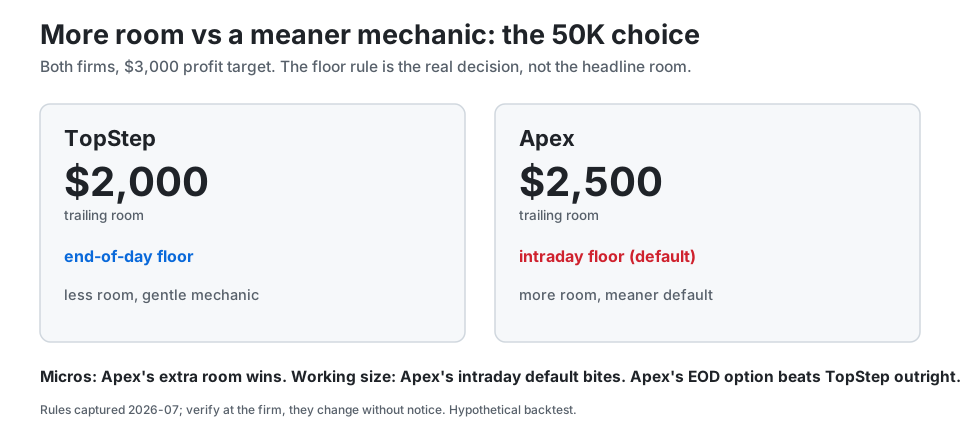
TopStep runs one floor, and it is end-of-day. Apex runs the bigger $2,500 buffer but lets you choose the basis, and the intraday version is the default a new trader lands on. So the head-to-head is really TopStep's simple end-of-day $2,000 against Apex's default intraday $2,500.
| 50K eval, captured 2026-07 | TopStep | Apex |
|---|---|---|
| Profit target | $3,000 (6%) | $3,000 (6%) |
| Trailing drawdown | $2,000 | $2,500 |
| Floor basis | End-of-day only | End-of-day or intraday (intraday is the default) |
| Pass condition | 5 winning days of $150+ | Best day under 50% of the target (from Mar 2026) |
| Profit split | 90/10 flat (from Jan 2026) | 100% of the first $10k, then 90/10 |
| Cost | ~$85 to $95/mo, free activation | ~$165/mo list, often $33 to $50 on sale |
Read across it and the choice stops being "which number is bigger." Apex has more room and a meaner default mechanic. TopStep has less room and the gentler mechanic. Which one wins depends on your size, and the crossover is the whole story.
One book, three floors, head to head
We funded a fresh $50,000 account, ran the same trades forward, and counted how often each floor busts the account. To strip out the luck of one trade ordering we did it as a 10,000-run Monte-Carlo, resampling whole trading days so each day's intraday sequence stays intact. Three floors: TopStep's end-of-day $2,000, Apex's default intraday $2,500, and Apex's optional end-of-day $2,500.
| Floor (all 50K) | 1 micro | 2 micros | 3 micros |
|---|---|---|---|
| TopStep, $2,000 end-of-day | 17.0% | 47.6% | 54.4% |
| Apex, $2,500 intraday (default) | 12.7% | 47.3% | 56.1% |
| Apex, $2,500 end-of-day (option) | 8.3% | 37.5% | 47.1% |
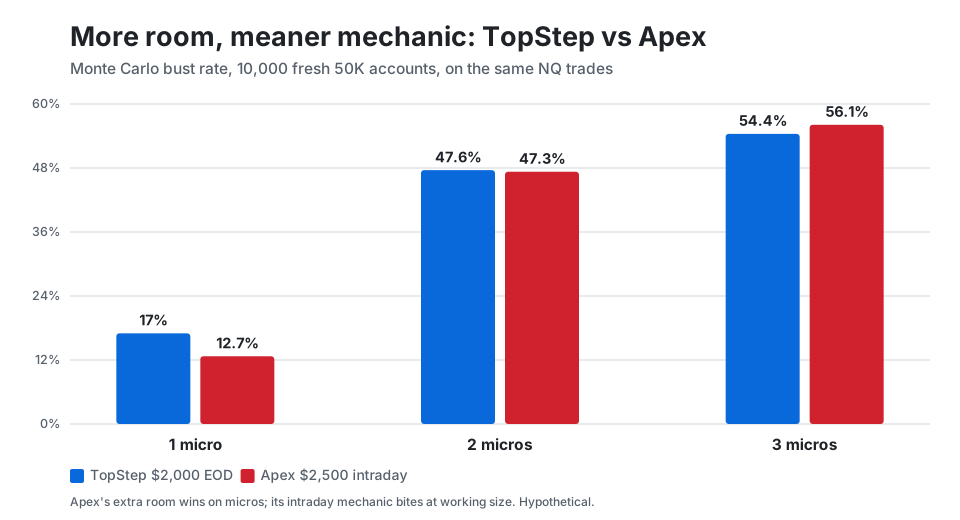
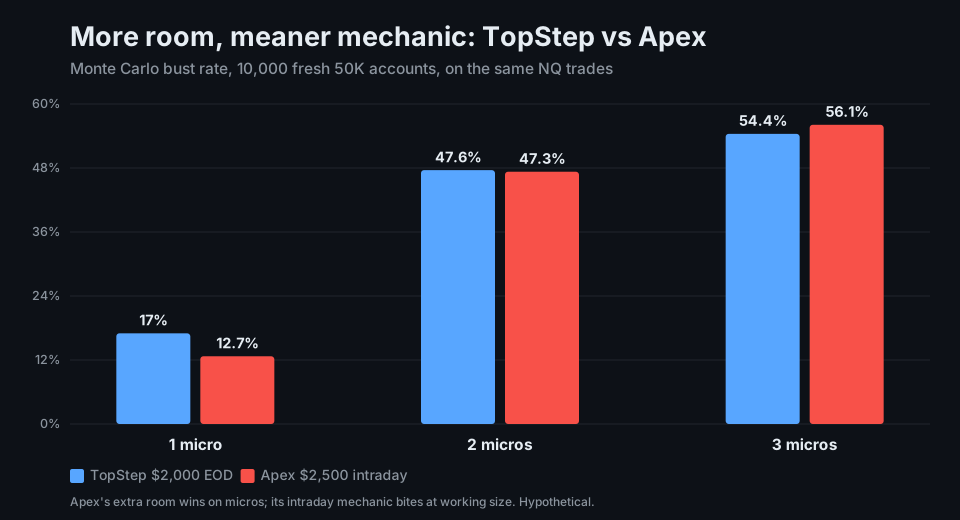
Watch the top two rows cross. At one micro Apex's extra room wins clean: 12.7% against 17.0%. At two micros they are a dead heat, 47.3% against 47.6%. At three micros the order has flipped, 56.1% against 54.4%. The $500 of extra room does not get smaller as you size up. Something else grows to overtake it.
More room, meaner mechanic: why the lines cross
That something is the ratchet. On the intraday floor, every open-trade high lifts your floor and locks it there. Measure how high Apex's intraday floor rides above its own end-of-day floor with the identical $2,500 buffer, and you get the exact cost of the mechanic: up to $286 higher at one micro, $542 at two, and $592 at three. Bigger size floats bigger open highs, so the intraday floor climbs further above where an end-of-day floor would sit.
Now line that cost up against the $500 of extra room Apex hands you over TopStep. At one micro the mechanic lifts the floor by at most $286, well under the $500 cushion, so Apex keeps a net edge. At two micros the lift is $542, which has just overtaken the $500 room, and the two floors draw even. At three micros the lift is $592, comfortably past the room, and Apex's default is now the tighter floor despite carrying more dollars. The crossover in the bust rates is not noise. It is the moment the meaner mechanic eats the extra room.
The mechanism deep-dive, with the trade-by-trade attribution of which sub trips the intraday floor, is its own piece on end-of-day versus intraday trailing drawdown.
Pick Apex's end-of-day option and it beats TopStep outright
The bottom row of the table is the quiet winner. Apex's end-of-day option carries the full $2,500 buffer and the gentle mechanic at once, so it busts the fewest accounts at every size: 8.3%, 37.5%, 47.1%.
Against TopStep it is not close. Both floors ratchet on the close, so they move in lockstep, and Apex's simply sits $500 lower the entire way. We funded a fresh account on every one of the 2,545 trading days in the book and ran each one forward under both rules. On zero of those dates did TopStep survive while Apex-EOD busted. On as many as one in five, Apex-EOD survived while TopStep busted. The extra room can only help you when the mechanic is the same. It never hurts.
So the practical order is simple. If you are choosing between the firms and you can put in the working size, Apex is the roomier account only if you switch it off the intraday default. Leave it on the default and at three micros you are on a tighter floor than TopStep, more dollars notwithstanding. TopStep's one end-of-day floor is genuinely simpler, and simple has value, but it is never the roomier choice.
Which firm and size actually survive our book
Here is the part that decides whether any of this matters for a follower of our signals. Our book's worst intrabar drawdown is $31,625 at one mini, which is $3,163 at one micro. That single number is larger than every 50K floor on this page.
Read what that means. If you funded a fresh account the day before the book's deepest dip and sized at one micro, a $3,163 excursion would blow through a $2,000 floor, a $2,500 floor, end-of-day or intraday, every one of them. No firm rule saves you from your own equity curve landing on the wrong day. The floor choice only changes the odds, not the ceiling.
That is why the honest answer to "which firm" is "which firm at which size, funded when." At one micro the odds favor Apex's room. At three micros they favor TopStep's mechanic over Apex's default, and Apex's end-of-day option over both. The full 15-year distribution these floors run on is on our strategies page and the live-tracked tear sheet.
Do not pick on the headline room number. On micros, Apex's extra $500 wins. If you use Apex, switch it to the end-of-day floor and it beats TopStep at every size. TopStep's single end-of-day floor is fine and simple, but it is never the roomier account. And on an intraday floor, size for the highest equity you touch mid-trade, not the profit you keep.
The rules, captured July 2026
Both firms sell a $50,000 eval with a $3,000 profit target, which is 6% of the account. The differences that matter sit around that shared number, and all of them were captured in the first week of July 2026.
TopStep runs a $2,000 end-of-day trailing floor, one basis, no choice. To pass you need five winning days of at least $150 each. The cost is roughly $85 to $95 a month with free funded-account activation, and since January 2026 the split is a flat 90/10 in your favor.
Apex runs a $2,500 trailing floor and lets you choose end-of-day or intraday, with intraday the default. Since March 2026 it carries a consistency rule that caps your best day at 50% of the target. List price is around $165 a month, though Apex discounts hard and often runs the eval at $33 to $50. On payouts you keep 100% of the first $10,000, then 90/10.
Treat every figure in this section as captured 2026-07, verify it at the firm before you act, and expect it to change without notice. Prop rulebooks move quarterly, and both of these did in the last six months. The three-firm version of this table, with MyFundedFutures added, is on the rules comparison.
How we measured this
Instrument: CME E-mini Nasdaq-100 (NQ), micro-scaled. Data: the TradingView list-of-trades export from our live five-strategy book, June 2011 through June 2026, 3,505 trades, $1,120,402 net, about $4.10 per contract round turn for commissions and slippage carried in the backtest. Account: the $50,000 evaluation tier at both firms, chosen so the contrast is same-size. Sizing: one micro per signal is one-tenth of the backtested mini size; two and three micros scale from there. Every account starts fresh at $50,000 and holds one position at a time.
Floor model. For each firm we set the drawdown distance, the ratchet basis, and the lock level from the July 2026 rule captures. End-of-day floors ratchet on the session's closing balance. Intraday floors ratchet on the intraday peak including open unrealized profit, reconstructed from each trade's favorable excursion. The breach is always checked intraday, on the worst intrabar equity of each trade. Bust rates are a 10,000-run Monte-Carlo that resamples whole trading days with replacement (seed 20260703) so each day's intraday order stays intact; the pairwise dominance test funds a fresh account on all 2,545 historical trading days and runs each forward under both rules.
What would prove this wrong. Run any book with the same two buffers through both floors. If the intraday floor does not bust more often than an end-of-day floor at the identical $2,500 buffer, or if Apex's end-of-day floor ever busts a funding date TopStep survives, the thesis is broken. On our trades neither happens, at any size.
Where this is wrong, and one limit we will name
The intraday-floor busts are a lower bound, on purpose. We assume the floor ratchets up the instant an open trade prints a new high, which overstates the true peak a lagging data feed would record, and so over-counts the intraday busts. The real gap between Apex's default and TopStep is therefore at least what we show, probably a touch smaller. We would rather overstate the intraday harshness than hide it, but you should read the crossover as directional, not as a precise margin.
And this is a what-if on TradingView's exported trades, not an in-engine backtest of a rule change. Our floor sim is an approximation layered on real fills. It cannot see within-bar sequencing, so a live floor could trip on a wick this method never models. We also did not simulate Apex's daily loss limit or either firm's payout mechanics beyond the floor, because the floor is what decides survival on this book. The variance behind all of it is the same one we walk through in why a profitable strategy still fails the trailing floor.
The floor definition is a sizing decision, not a footnote. On micros, take Apex's room. On Apex at any size, take the end-of-day option and you are strictly better off than on TopStep. If you want the signals these floors were run on, that is the one thing we sell.
STS Research. Educational content, not investment advice. The 15-year record here is a TradingView backtest of our systematic book, not a live track record; we trade this book and sell access to its signals, so judge the data accordingly. We are not affiliated with TopStep, Apex Trader Funding, or any prop firm. All rule figures were captured in July 2026 and change without notice.
CFTC Rule 4.41: Hypothetical or simulated performance results have certain limitations. Unlike an actual performance record, simulated results do not represent actual trading. Also, since the trades have not been executed, the results may have under- or over-compensated for the impact, if any, of certain market factors, such as lack of liquidity. Simulated trading programs in general are also subject to the fact that they are designed with the benefit of hindsight. No representation is being made that any account will or is likely to achieve profit or losses similar to those shown.
Past performance is not indicative of future results.