From Signal to Inbox in Seconds: How Fast STS NQ Alerts Reach You, Timed on Live Emails
Short answer. Half of a typical STS alert's emails were confirmed delivered within 12 seconds of the signal, and on 69 of the 78 alerts timed from September 3 to November 13, 2026, every email was confirmed within 30 seconds. Every email on all 114 alerts we logged since July 29 left within 37 seconds, and our server pushed each signal to the dashboard's live feed a median 3 seconds after it fired.
How fast does an STS alert email reach me?
Within about 12 seconds on a typical alert: by then half of its emails had been confirmed delivered, at the median, or middle value, of 78 alerts from September 3 to November 13, 2026. That is the time from the signal to our email provider confirming delivery to the recipient's mail server.
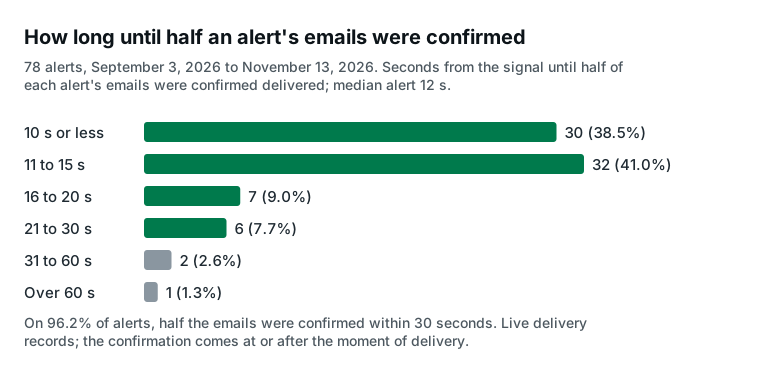
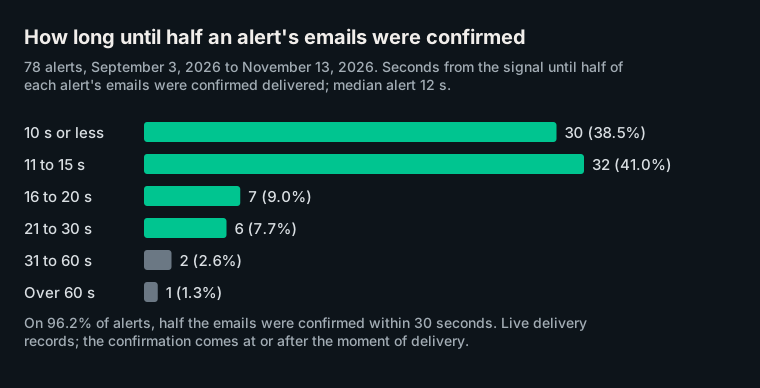
The confirmation arrives at or after the moment of delivery, so the real figures are, if anything, a little faster. On 69 of the 78 alerts (88.5%) every email was confirmed within 30 seconds, and on 71 (91.0%) within a minute.
Where do those seconds go?
Three steps, each timed from our own records: the signal reaches us, we email every member, and the email is delivered.
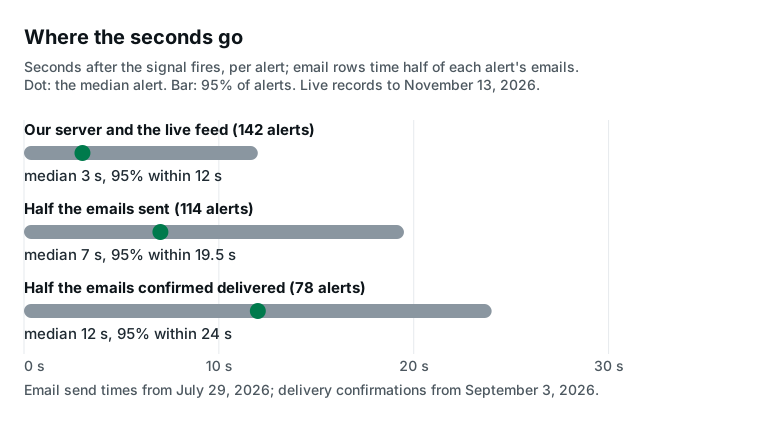
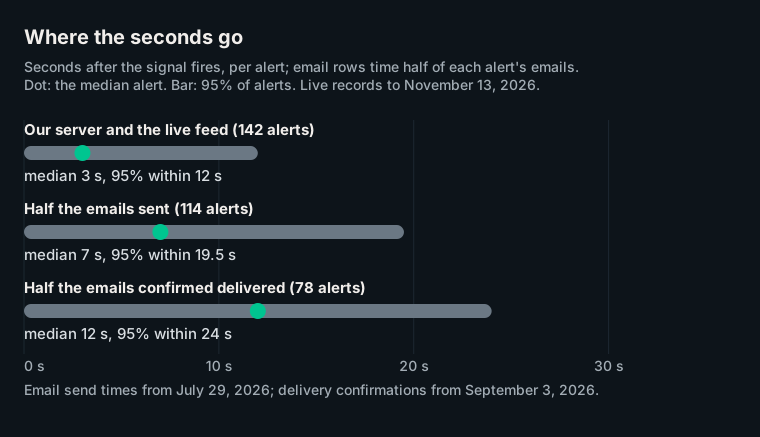
The signal reaches us. Each signal reaches our server a median 3 seconds after it fires, and all 142 live alerts since July 6, 2026 arrived within 23 seconds. The dashboard's live feed updates as we process the alert, which took a median 44 milliseconds.
We email every member. Members are emailed one after another. On the median alert, the first email left 3 seconds after the signal, half had left by 7 seconds and the last by 10.5 seconds, and every email on all 114 alerts we logged left within 37 seconds.
Your mail server accepts it. Our provider handed the email on and confirmed delivery: half of a typical alert's emails within 12 seconds of the signal.
How do I get each alert as fast as possible?
Keep the dashboard open while you trade, and make sure your email reaches you instantly. Each alert carries what you need to act: an entry gives the direction, the contract count, the price and the time in ET, and an exit adds the entry price, the exit price and how long the trade lasted. The dashboard also tags which strategy fired.
- Watch the live feed. It is the fastest channel.
- Add alerts@stsfutures.com to your contacts so alerts are not filtered as spam.
- Set your phone's mail app to push new mail rather than check on a timer. Browser push is also available.
You place every order yourself on your own platform: there is no broker connection, no automation and no bot. For when in the day alerts tend to arrive, see the best time to trade NQ futures, and for how many to expect in a week, how often NQ signals fire.
How we measured this
These are delivery records from our own systems. Each signal carries its own timestamp, to the second, of when it fired. We compare it with when our server received the alert, when each email was handed to our email provider, and when the provider's delivery confirmation reached us.
Server timing covers all 142 live alerts (71 entries and 71 exits) from July 6 to November 13, 2026. Send timing covers the 114 alerts from July 29, when we began logging each email, and delivery timing the 78 alerts from September 3, when delivery confirmations began. We time every email on an alert and report per alert: its first email, its last, and the point by which half had left or been confirmed. Times are whole seconds and percentiles are nearest-rank.
Not counted: emails a member has switched off, which are not sent, and emails sent after 2 repeated exit signals. On 7 of the 78 timed alerts at least one email took over a minute to confirm, and on 5 over two minutes; on 2 of those the recipient's mail server held an email back, and on 2 alerts an email bounced. When your own mail app or browser shows the alert is outside what we can measure. These figures describe delivery speed, not trading results.
What this means for you
An STS alert is on its way while the signal is fresh: on the dashboard's live feed a median 3 seconds after the signal, with half of a typical alert's emails confirmed delivered within 12 seconds and every email sent within 37 seconds. You read it, decide, and place the order yourself. Membership is $50 a month or $500 a year, and you can cancel anytime; see pricing.
We trade this book live and sell access to the signals, so judge the data accordingly. This article is educational and is not investment advice. Futures trading involves substantial risk of loss and is not suitable for every investor.
Hypothetical Performance Disclaimer (CFTC Rule 4.41): These results are based on simulated or hypothetical performance results that have certain inherent limitations. Unlike the results shown in an actual performance record, these results do not represent actual trading. Also, because these trades have not actually been executed, these results may have under- or over-compensated for the impact, if any, of certain market factors, such as lack of liquidity. Simulated or hypothetical trading programs in general are also subject to the fact that they are designed with the benefit of hindsight. No representation is being made that any account will or is likely to achieve profits or losses similar to these being shown.
Past performance is not necessarily indicative of future results. Futures trading involves substantial risk of loss and is not suitable for all investors.
See what STS NQ futures signals are and how they reach you and our forward record, every live signal we have sent, dated and public.