NQ trade alerts vs Discord rooms vs copy bots: one clear STS email per signal, no bot in your account
Short answer. STS sends one email for each NQ entry and one for each exit, and every entry email carries the same four facts: direction, contract count, price and time in ET. You place the order yourself, so there is no chat to decode and no software in your broker account. In our 15-year hypothetical backtest the four-strategy book held one position at a time across all 3,139 trades and averaged 4.02 trades a week, about 8 alert emails counting each entry and exit.
How do trade alerts, Discord rooms and copy bots differ?
Two things separate them: the form a trade arrives in, and who places the order.
A chat room leaves the order with you, but each call takes whatever shape its author types. A copy bot works the other way round: the process is fixed and the software places the order. An STS alert keeps the fixed format and leaves the order with you.
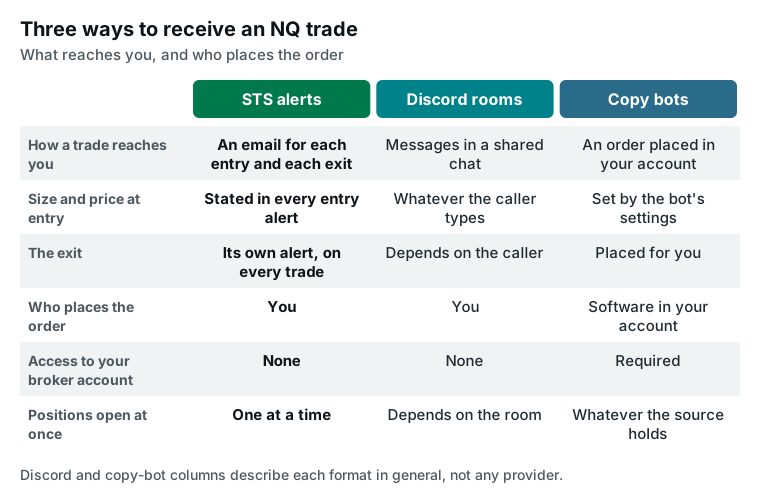
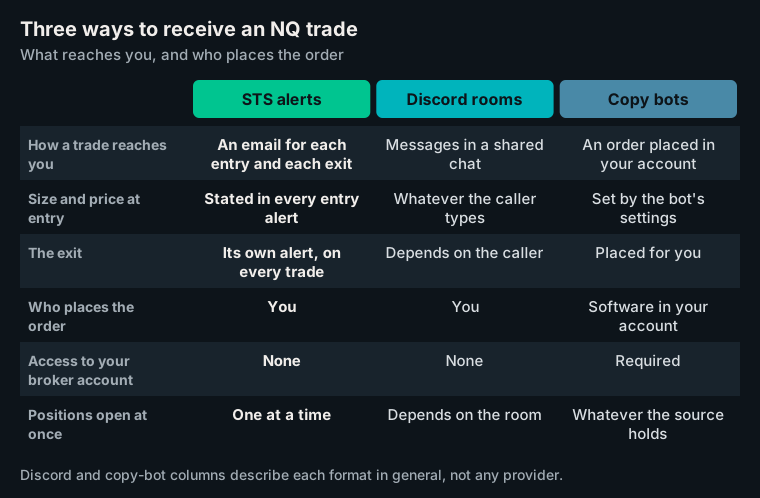
Why is one email per signal easier to act on than a chat room?
Because every email answers the same questions in the same place. The entry gives direction, contract count, price and time in ET; the exit adds the entry price, the exit price and how long the trade lasted.
In a chat, a call sits between other messages and reads however its author wrote it. You scroll, work out which trade a message refers to, then act.
STS removes that step because the book holds one position at a time. In our hypothetical backtest, no trade opened before the previous one had closed, in all 3,139 trades. So an exit alert always refers to the one trade you are in.
Here is a median week from that backtest: 4 trades, 8 alert emails and two quiet days.
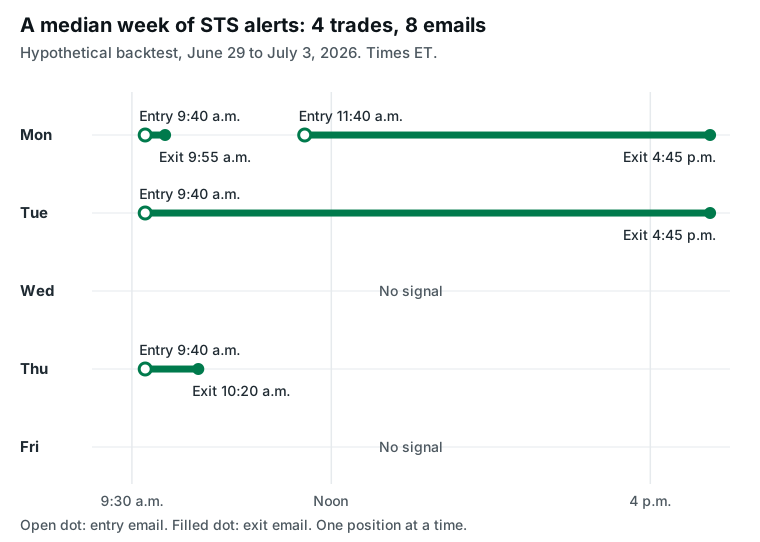
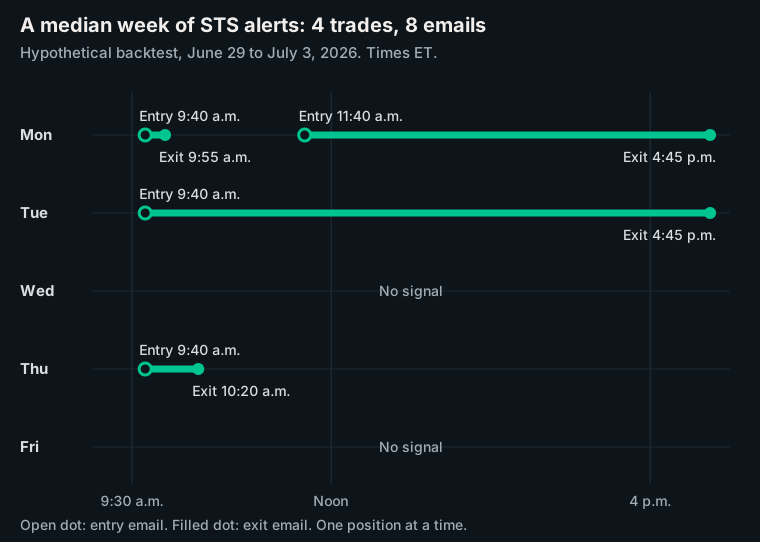
Over all 781 whole weeks of the backtest the average was 4.02 trades. Of the 51 weeks with no signal, 42 were the quarterly roll week, when NQ moves to its next contract; how often NQ signals fire explains the pattern.
Why place the order yourself instead of running a copy bot?
Because your account stays in your hands. A copy bot needs access to your broker account to place orders. STS has no broker connection, no automation and no bot, so nothing is ever placed for you.
The trade-off is speed: a bot acts the moment a signal fires, and you act when you see the alert.
You also choose the size. Each entry states a contract count in NQ. You can follow at that size or in MNQ, the micro contract, which is one tenth of an NQ contract; NQ vs MNQ compares the two.
Where do the alerts arrive?
In your inbox and on the dashboard. Every entry and every exit is emailed from alerts@stsfutures.com and appears on the web dashboard's live feed, tagged with which of the four strategies fired. Browser push is optional.
What this means for you
If you want to follow a systematic NQ book without reading a chat or handing your account to software, a fixed-format email is the simplest of the three. You need an inbox and a futures platform.
STS costs $50 a month or $500 a year. Cancel anytime in Settings, and access runs to the end of the period you paid for. See the plans.
How we compared
The STS column describes the alerts and dashboard as they work today; the other two columns describe each format in general.
Week, trade and position counts come from our hypothetical backtest of the four-strategy NQ book: 3,139 trades from 2011 to 2026, data as of November 6, 2026, NQ mini, 1 or 2 contracts a trade (2 when daily ranges are small, 1 when they are large; every trade since July 2024 has been 1 contract). They count simulated trades; they are not results of live trading.
Weeks are the 781 whole Monday-to-Friday weeks in the record, counted on entry time in ET, with a Sunday-evening entry counted toward Monday. Two open positions would show up as an entry earlier than the previous exit; there were none.
We trade this book live and sell access to the signals, so judge the data accordingly. This article is educational and is not investment advice. Futures trading involves substantial risk of loss and is not suitable for every investor.
Hypothetical Performance Disclaimer (CFTC Rule 4.41): These results are based on simulated or hypothetical performance results that have certain inherent limitations. Unlike the results shown in an actual performance record, these results do not represent actual trading. Also, because these trades have not actually been executed, these results may have under- or over-compensated for the impact, if any, of certain market factors, such as lack of liquidity. Simulated or hypothetical trading programs in general are also subject to the fact that they are designed with the benefit of hindsight. No representation is being made that any account will or is likely to achieve profits or losses similar to these being shown.
Past performance is not necessarily indicative of future results. Futures trading involves substantial risk of loss and is not suitable for all investors.
See what STS NQ futures signals are and how they reach you and our forward record, every live signal we have sent, dated and public.