NQ Signals Outside the US: STS Prices, Session Times in Your Zone and Trading Through Your Own Broker
Short answer. STS works the same from Canada, the UK or Australia: alerts arrive by email and on the dashboard, and you place the order at a broker such as Interactive Brokers, which lists NQ and Micro NQ (MNQ) futures in all three. The plan is $50 a month in US dollars; at checkout Stripe may show it as about C$73 to C$74, £39 or A$75 to A$76 at November 13, 2026 rates. In London, every one of our 3,139 hypothetical backtest entries landed between noon and midnight.
Does STS work if I live outside the US?
Yes. The signals are emails and a web dashboard, and the orders are yours, so only the broker depends on where you live.
- Each entry and each exit arrives by email from alerts@stsfutures.com and on the dashboard's live feed. Browser push is optional.
- An entry alert gives the direction, contract count, price and time in ET (New York time). The exit alert adds entry price, exit price and duration.
- You place your own orders on CME NQ or MNQ. There is no broker connection and no bot, so any broker that accepts you and trades those contracts works.
What does STS cost in Canadian dollars, pounds or Australian dollars?
$50 a month or $500 a year, priced in US dollars. At checkout, Stripe may show the price in your currency: about C$73 to C$74, £39 or A$75 to A$76 a month at November 13, 2026 rates. You see the exact amount before you pay.
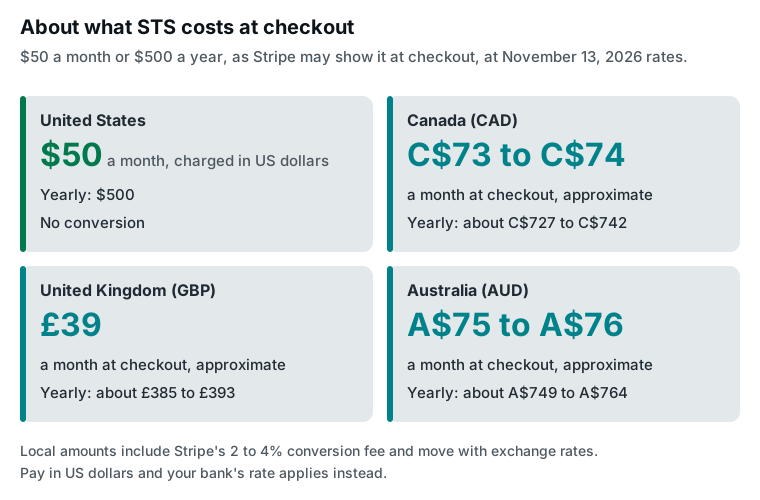
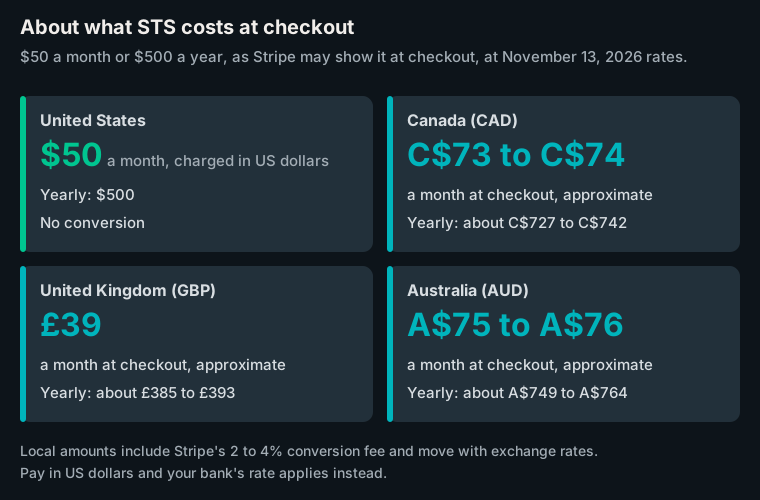
That local amount includes Stripe's 2 to 4% conversion fee. Pay in US dollars instead and that fee falls away, though your bank's exchange rate and fees may apply. Either way, you can cancel anytime in Settings and keep access to the end of the period you paid for.
What time do STS signals arrive where I live?
In Canada and the UK, during the day or evening: every one of the 3,139 entries in our hypothetical backtest landed between 6 a.m. and midnight local time in Toronto, Vancouver and London.
These are entry times from our hypothetical backtest of the four-strategy NQ book, which holds one position at a time. They show when the rules fired, not what the trades earned. In New York time, 55.4% of entries came in the first hour after the 9:30 a.m. open, and 25.7% after NQ reopens at 6 p.m.
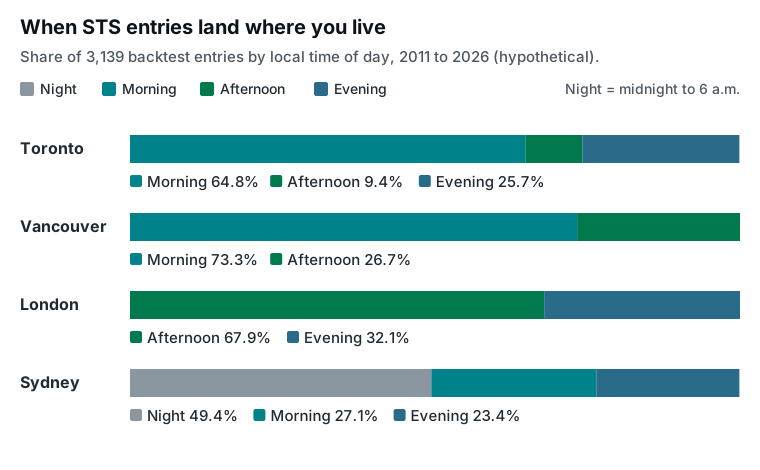
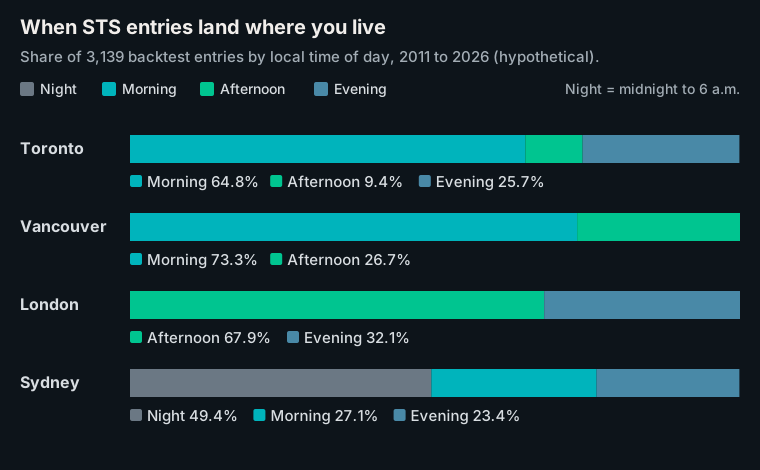
In London, no backtest entry landed at night, and 71.4% landed between 2 p.m. and 9 p.m. In Vancouver, 64.8% landed between 6 a.m. and 9 a.m., before most workdays start. Toronto runs on the same clock as the alerts.
In Sydney, the New York open falls after midnight, so 49.4% of entries landed between midnight and 6 a.m., and the rest in the morning or late evening.
Here is the US market's regular session, 9:30 a.m. to 4 p.m. ET, and NQ's 6 p.m. ET evening open on your clock.
| City | Nov 2, 2026 to Mar 13, 2027 | 6 p.m. ET open | Apr 4 to Oct 2, 2027 | 6 p.m. ET open |
|---|---|---|---|---|
| Toronto | 9:30 a.m. to 4:00 p.m. | 6:00 p.m. | 9:30 a.m. to 4:00 p.m. | 6:00 p.m. |
| Vancouver | 6:30 a.m. to 1:00 p.m. | 3:00 p.m. | 6:30 a.m. to 1:00 p.m. | 3:00 p.m. |
| London | 2:30 p.m. to 9:00 p.m. | 11:00 p.m. | 2:30 p.m. to 9:00 p.m. | 11:00 p.m. |
| Sydney | 1:30 a.m. to 8:00 a.m. | 10:00 a.m. | 11:30 p.m. to 6:00 a.m. | 8:00 a.m. |
In the weeks between, clocks change on different dates: London runs one hour earlier from March 14 to 27 and from October 31 to November 6, 2027, and Sydney runs 12:30 a.m. to 7:00 a.m. from March 14 to April 3 and from October 3 to November 6.
A busy backtest hour is not a promise for any given week; some weeks are quiet. See how often our NQ signals fire.
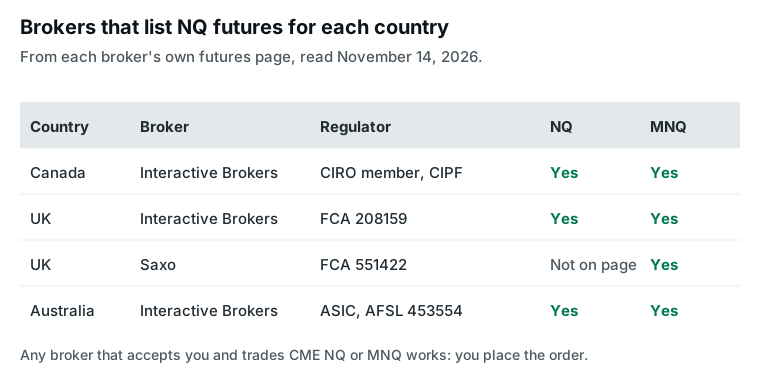
Which brokers let me trade NQ from Canada, the UK or Australia?
Interactive Brokers lists NQ futures, with micro contracts, through a locally regulated company in all three countries. In the UK, Saxo also lists the Micro E-mini Nasdaq 100, at USD 3 commission per contract. Each broker decides whether to accept you and give you futures permission.
MNQ is the size option. One MNQ contract is one tenth of an NQ contract, so you can follow any NQ signal at a tenth of the size. The contract math is in NQ vs MNQ.
How we measured this
- Timing. 3,139 hypothetical entries from our TradingView backtest of the four-strategy NQ book, 2011 to 2026, data as of November 6, 2026, each converted from New York time to local time with that date's daylight saving rules. Night is midnight to 6 a.m., morning 6 a.m. to noon, afternoon noon to 6 p.m., evening 6 p.m. to midnight.
- Session table. 9:30 a.m., 4:00 p.m. and 6:00 p.m. New York time, converted for each date from November 2, 2026 to November 6, 2027.
- Prices. $50 and $500 converted at November 13, 2026 daily closing rates (C$1.4261, £0.7558 and A$1.4691 per US dollar), then raised by 2% and 4%, the conversion fee Stripe states for local-currency checkout, and rounded to whole units. Stripe sets its own rate on the day, so these are approximate.
- Brokers. Each broker's own CME futures page, read November 14, 2026.
What this means for you
If you live in Canada or the UK, STS runs on your waking hours: in our backtest, no entry reached Toronto, Vancouver or London between midnight and 6 a.m. In Sydney, plan for alerts after midnight.
Before your first signal, get futures permission at a broker that lists NQ or MNQ. Then check the local price on the pricing page.
We trade this book live and sell access to the signals, so judge the data accordingly. This article is educational and is not investment advice. Futures trading involves substantial risk of loss and is not suitable for every investor.
Hypothetical Performance Disclaimer (CFTC Rule 4.41): These results are based on simulated or hypothetical performance results that have certain inherent limitations. Unlike the results shown in an actual performance record, these results do not represent actual trading. Also, because these trades have not actually been executed, these results may have under- or over-compensated for the impact, if any, of certain market factors, such as lack of liquidity. Simulated or hypothetical trading programs in general are also subject to the fact that they are designed with the benefit of hindsight. No representation is being made that any account will or is likely to achieve profits or losses similar to these being shown.
Past performance is not necessarily indicative of future results. Futures trading involves substantial risk of loss and is not suitable for all investors.
See what STS NQ futures signals are and how they reach you and our forward record, every live signal we have sent, dated and public.