How Much Time Do STS NQ Signals Take? Minutes a Week, Not a Trading Session
Short answer. Following STS means acting on 4.02 trades a week in our 15-year hypothetical backtest, about 8 alert emails counting each entry and exit. At one to two minutes per order, that is 8 to 16 minutes a week, against 32.5 hours for watching the regular session yourself. Most alerts land in the first hour after the 9:30 a.m. ET open or outside the regular session, so you act when one arrives instead of watching a chart.
Every figure here comes from the hypothetical backtest of our four-strategy NQ futures book: 3,139 trades from 2011 to 2026, one position at a time. An alert is one email and one line on the dashboard's live feed: an entry, or an exit.
How many alerts will I act on in a week?
About 8 on average, and 12 or fewer in 85.0% of weeks. That is 4.02 trades a week across 781 whole weeks of the backtest, each with an entry and an exit alert.
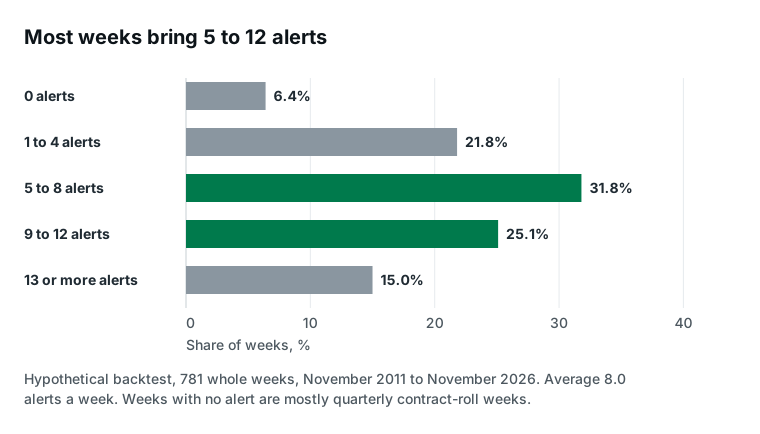
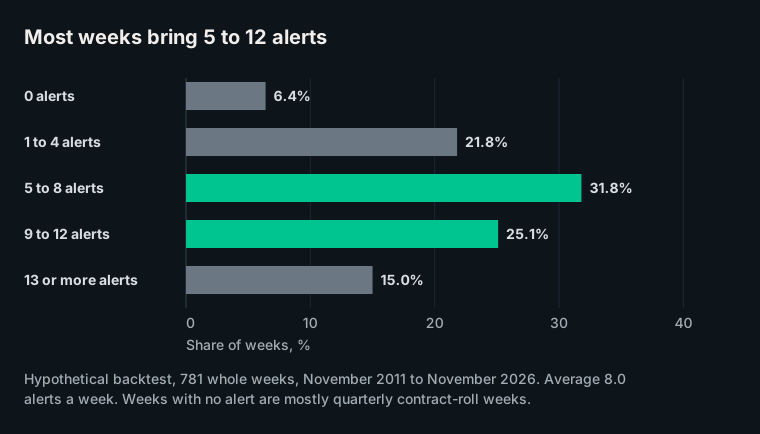
About three weekdays in five (61.2%) had at least one alert. On those days the median was 2: one trade in, one trade out.
Most quiet weeks are predictable. More than four in five weeks with no alert were the quarterly contract-roll week, when the book usually takes no new entries.
How many minutes does that add up to?
About 8 minutes a week at one minute per order, and about 16 at two. The alert count is measured; the minutes per order are our assumption, because your platform sets the speed.
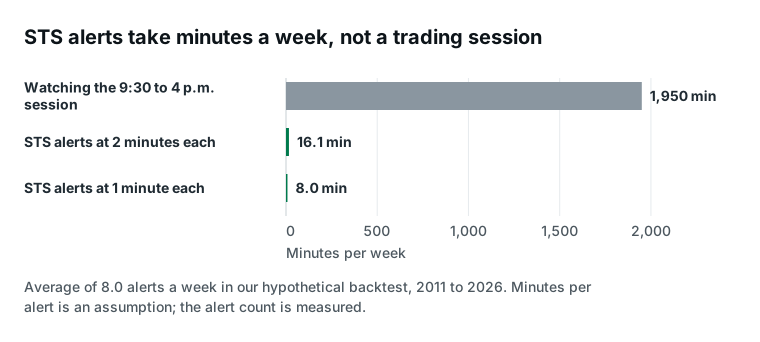
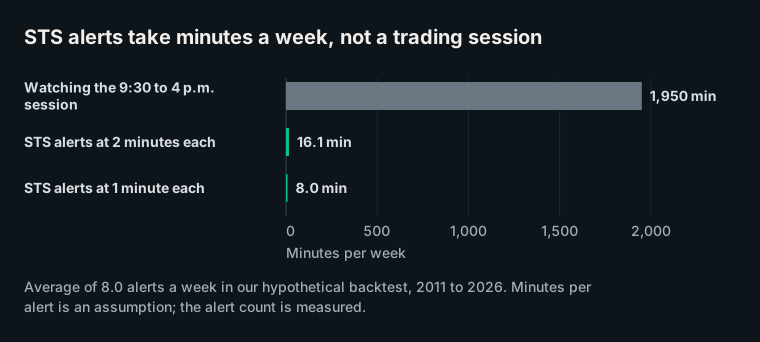
The regular session runs from 9:30 a.m. to 4 p.m. ET, 6.5 hours a day and 32.5 hours a week. That is the window you would watch to find setups yourself.
An STS alert removes the analysis. The entry gives the direction, contract count, price and time in ET. The exit adds the entry price, the exit price and how long the trade lasted. You read it and place the order.
When do I need to be reachable?
Mostly in the first hour after the 9:30 a.m. ET open or outside the regular session. The first hour alone brings 35.6% of all alerts, and only 21.6% land between 10:30 a.m. and the 4 p.m. close.
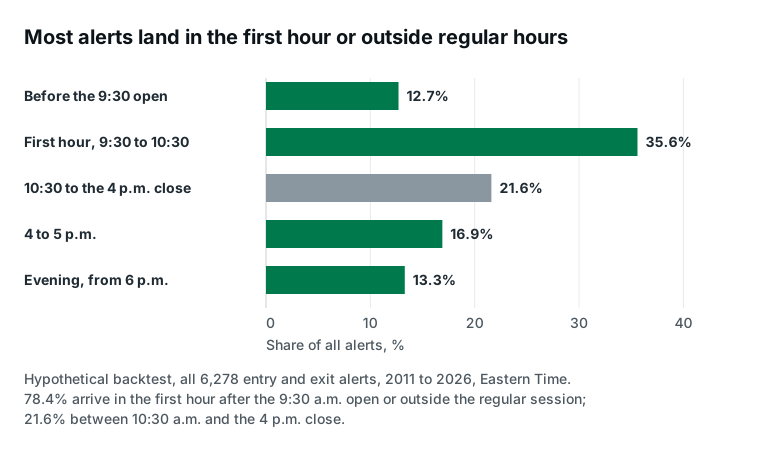
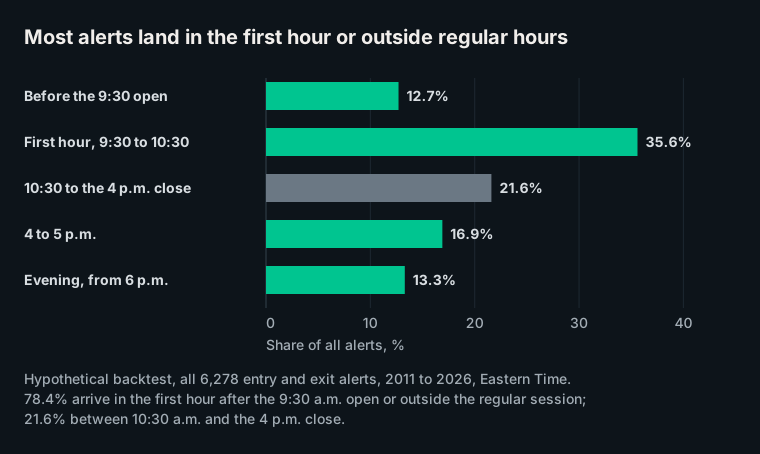
Entries cluster hardest: 55.4% of all trades opened in the first hour. Another 16.9% of alerts land between 4 and 5 p.m., all of them exits, and 13.3% come in the evening, almost all of them entries. Only 1.1% arrive between midnight and 6 a.m.
Of the alerts between 10:30 a.m. and the close, 56.2% are exits. For signal counts by week, month and year, see how often NQ signals fire.
Does an open trade add to that time?
No. The exit arrives as its own alert, and the median trade ran 5 hours 40 minutes between its entry and exit alerts.
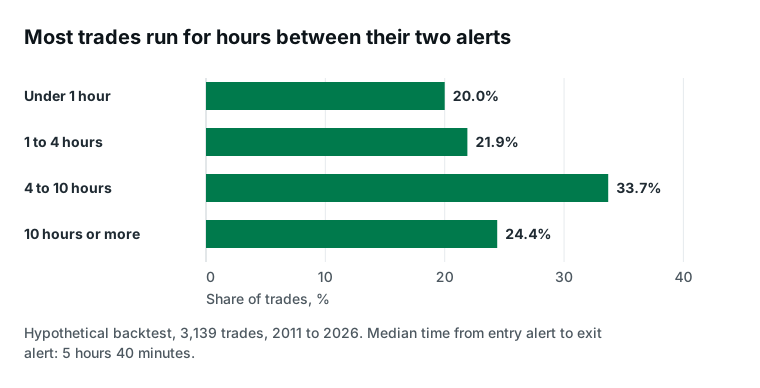
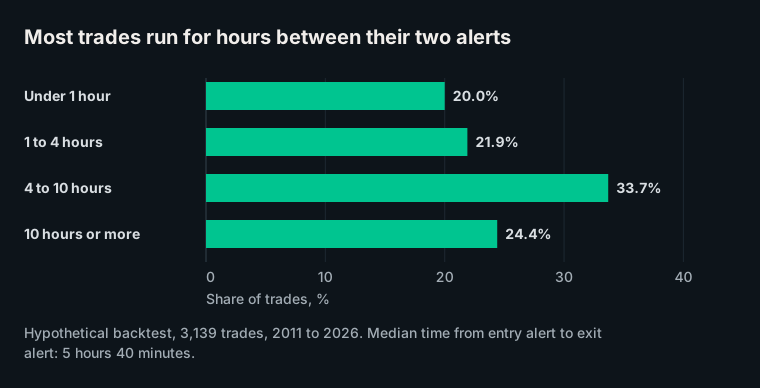
The entry alert carries no stop or target. The exit alert is your cue to close, so the one thing to protect is your attention when it arrives.
These are our book's hours; a different system keeps different ones, and who STS is not for covers the schedules it does not fit.
How we measured this
- Data: our backtest of the four-strategy NQ book, data as of November 6, 2026: 3,139 round trips from November 16, 2011 to November 6, 2026, NQ mini, 1 or 2 contracts a trade (2 when daily ranges are small, 1 when they are large; every trade since July 2024 has been 1 contract), commissions and slippage included. All results are hypothetical.
- Counting: each trade sends two alerts, its entry and its exit. Times are Eastern. A Sunday-evening alert counts toward Monday. Weeks are the 781 whole Monday-to-Friday weeks in the record; exchange holidays are not removed.
- Minutes: the alert count is measured. One or two minutes per order is an assumption, and a slower or faster platform moves the minutes in proportion.
- What would change it: a different signal rate. The book has run quieter years and busier ones, so a given year can sit below or above the 15-year average.
What this means for you
If you can act on a phone alert within a few minutes when one lands, following STS costs minutes a week rather than a trading session. Most land around the open, late in the afternoon and in the evening. Add alerts@stsfutures.com to your contacts so every alert lands in your inbox. Browser push is there too if you want it.
You place every order yourself; nothing is placed for you. STS is $50 a month or $500 a year, and you can cancel anytime in Settings. See the plans.
We trade this book live and sell access to the signals, so judge the data accordingly. This article is educational and is not investment advice. Futures trading involves substantial risk of loss and is not suitable for every investor.
Hypothetical Performance Disclaimer (CFTC Rule 4.41): These results are based on simulated or hypothetical performance results that have certain inherent limitations. Unlike the results shown in an actual performance record, these results do not represent actual trading. Also, because these trades have not actually been executed, these results may have under- or over-compensated for the impact, if any, of certain market factors, such as lack of liquidity. Simulated or hypothetical trading programs in general are also subject to the fact that they are designed with the benefit of hindsight. No representation is being made that any account will or is likely to achieve profits or losses similar to these being shown.
Past performance is not necessarily indicative of future results. Futures trading involves substantial risk of loss and is not suitable for all investors.
See what STS NQ futures signals are and how they reach you and our forward record, every live signal we have sent, dated and public.