No code, no VPS, no broker API: STS signals vs running your own NQ bot
Short answer. Running your own NQ bot means owning six moving parts, from a tested strategy to a server that stays online whenever the bot may trade, up to the 115 hours a week NQ is open. STS signals need two: an inbox or the dashboard, and the platform you already use. On one cloud setup, the bot's server and broker API alone cost $54.99 a month before market data or a strategy; STS costs $50 a month with the signals included.
What does it take to run your own NQ bot?
Six parts, and each one has to keep working. With STS you need two.
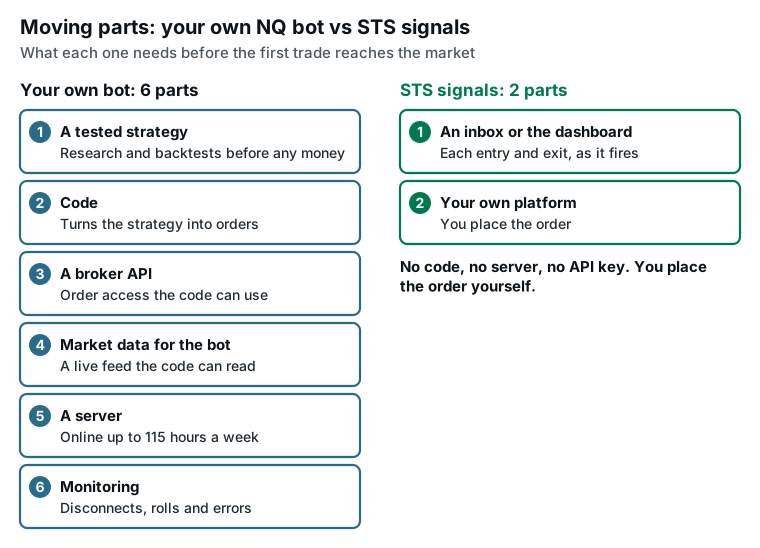
The strategy is the hard part, and the rest only matters once you have one; how to build a profitable NQ strategy sets out what that takes.
Then come the costs. At Tradovate, for example, API access, the connection that lets code place orders in your account, is a $25-a-month add-on that needs a live brokerage account with a balance of at least $1,000. It does not include real-time market data: to stream prices through the API you must become a CME sub-vendor under CME's information license.
STS needs none of that. There is no broker connection, no automation and no bot: each entry and exit arrives by email from alerts@stsfutures.com and on the web dashboard's live feed, and you place the order yourself.
How many hours does a bot have to stay online?
Every hour it may trade or hold a position. NQ trades from Sunday 6 p.m. to Friday 5 p.m. ET, with a one-hour pause at 5 p.m. each weekday: 115 hours a week.
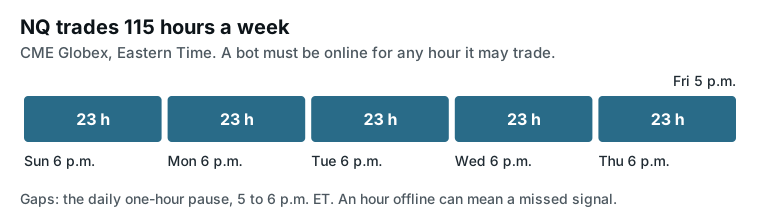
A laptop that sleeps or loses its connection mid-session takes the bot offline with it. The usual fix is a VPS, a rented server that stays online. The NQ contract specs list the session hours.
With STS, keeping the signal engine running is our job. You only need to see the alert during the hours you choose to trade.
What does the plumbing cost each month?
On one cloud setup, $54.99 before the bot has data or a strategy. That is the lowest monthly plan on one trading-VPS provider's price page, $29.99, plus Tradovate's $25 API add-on.
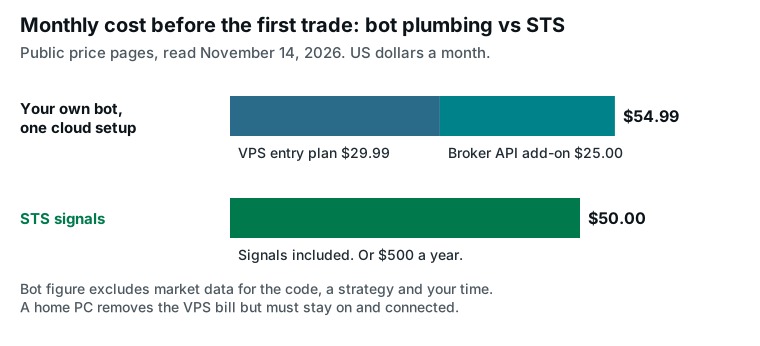
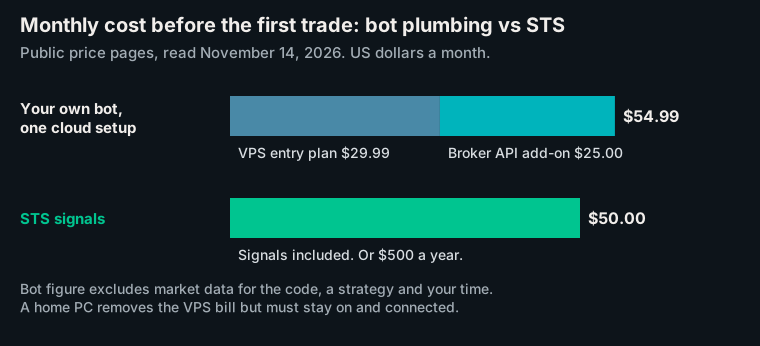
Other hosts and brokers price differently, and a home PC removes the hosting bill if it stays on and connected whenever the bot may trade. The strategy, the code and your time are not on the bill at all.
What do I give up compared with a bot?
Speed of execution: you place each order yourself, so you need to see the alert. In return, nothing trades in your account unless you do it.
You can skip a signal, trade it smaller in MNQ, the micro contract that is one tenth of an NQ, or follow on any platform that trades CME NQ or MNQ.
What this means for you
If you want a systematic NQ book without building and running one yourself, STS sends you the signals of its four-strategy book and leaves the platform and the orders to you.
STS costs $50 a month or $500 a year. Cancel anytime in Settings, and access runs to the end of the period you paid for. See the plans.
How we checked
We read each source on November 14, 2026. NQ trading hours come from CME Group's NQ contract specifications.
The API price, account minimum and market-data terms come from Tradovate's API access help article, updated September 16, 2026. The hosting price is the lowest monthly plan on one trading-VPS provider's public price page.
"One cloud setup" means that hosting plan plus that API add-on, and nothing else. Different hosts and brokers will give a different total; we compare it with STS's monthly price to show the scale, not to price every setup.
We trade this book live and sell access to the signals, so judge the data accordingly. This article is educational and is not investment advice. Futures trading involves substantial risk of loss and is not suitable for every investor.
Hypothetical Performance Disclaimer (CFTC Rule 4.41): These results are based on simulated or hypothetical performance results that have certain inherent limitations. Unlike the results shown in an actual performance record, these results do not represent actual trading. Also, because these trades have not actually been executed, these results may have under- or over-compensated for the impact, if any, of certain market factors, such as lack of liquidity. Simulated or hypothetical trading programs in general are also subject to the fact that they are designed with the benefit of hindsight. No representation is being made that any account will or is likely to achieve profits or losses similar to these being shown.
Past performance is not necessarily indicative of future results. Futures trading involves substantial risk of loss and is not suitable for all investors.
See what STS NQ futures signals are and how they reach you and our forward record, every live signal we have sent, dated and public.