Use STS signals on the platform you already have: Tradovate, NinjaTrader, Rithmic
Short answer. STS works on any platform that can trade CME NQ or MNQ futures, because you place every order yourself. Tradovate, NinjaTrader and Rithmic's R | Trader Pro all qualify: on November 14, 2026, Tradovate's and NinjaTrader's own pages listed NQ and MNQ, and R | Trader Pro's listed CME Group. There is nothing to install and no account to connect.
Which platforms can I use STS with?
Any platform that trades CME NQ or MNQ. We checked three of them on their own public pages.
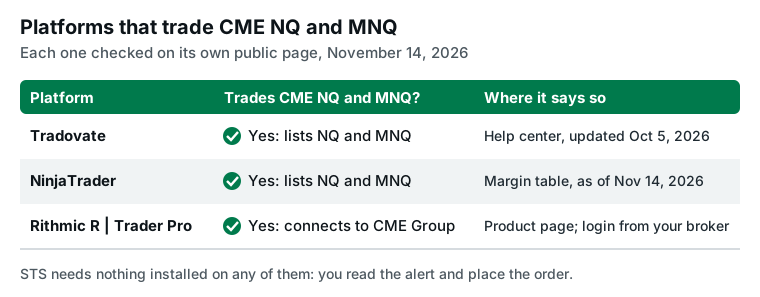
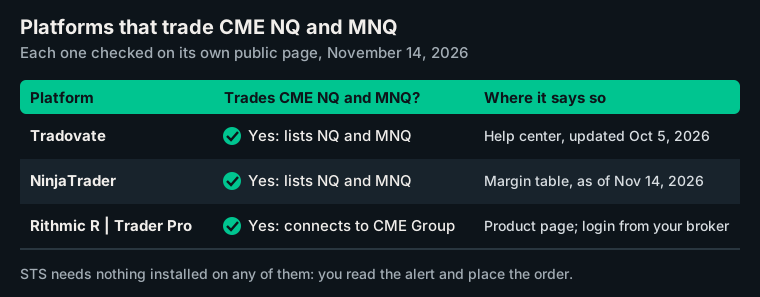
- Tradovate. Its help center lists NQ and MNQ among the CME equity index futures it offers (updated October 5, 2026).
- NinjaTrader. Its margin table lists the E-mini Nasdaq-100 (NQ) and the Micro E-mini Nasdaq-100 (MNQ), both on CME (margins as of November 14, 2026).
- Rithmic. R | Trader Pro, Rithmic's own trading platform, lists CME Group among its exchanges. It runs on Windows, in a browser and on iOS and Android, with a login from your broker.
Why does STS work on all of them?
Because STS never touches your account. There is no broker connection, no automation and no bot, so there is nothing to install and no API key to hand over.
The alert is information, and the order is yours. You can switch platforms, or follow on two, and nothing changes on our side.
How do I turn an alert into an order?
Copy it onto your platform's order ticket. Here is an entry from our hypothetical backtest, a short on October 7, 2025, as an example.
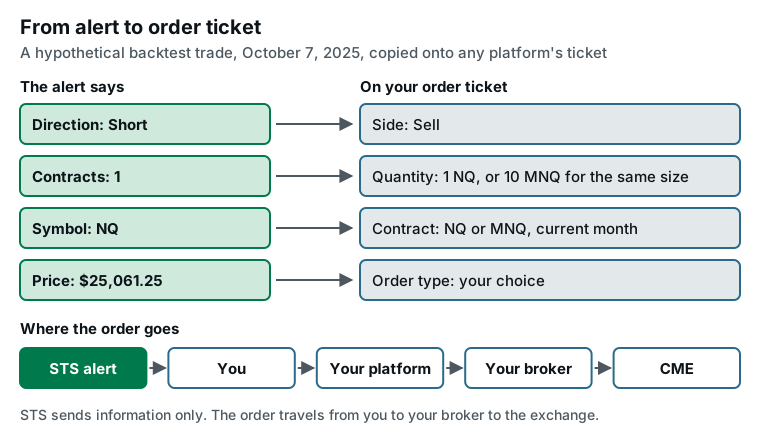
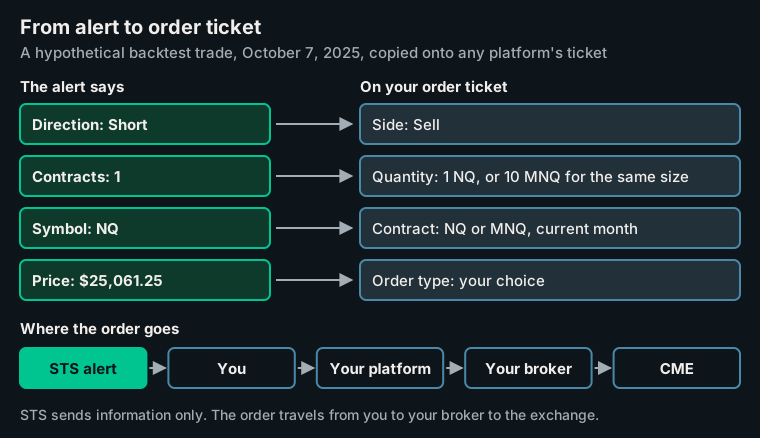
The direction sets the side: Long is a buy, Short is a sell. Contracts are counted in NQ. One MNQ is a tenth of an NQ, so 1 NQ is the same size as 10 MNQ, and you can always trade smaller.
An NQ point is worth $20 and an MNQ point $2; NQ vs MNQ compares the two.
Pick the current contract month. NQ and MNQ roll every quarter, and our roll calendar lists the dates. The order type, such as market or limit, is your choice.
When the exit alert arrives, close the same quantity on the opposite side.
When do I need my platform within reach?
Mostly at two times of day. In our hypothetical backtest, 55.4% of the 3,139 entries came in the first hour after the 9:30 a.m. ET open, and 25.7% after NQ reopens at 6 p.m. ET.
The rest arrived between 10:30 a.m. and the 4 p.m. close. Each exit then comes on its own alert, so keep the platform within reach while a trade is open.
Because you place the order yourself, you can do it wherever your platform runs; R | Trader Pro, for one, also works in a browser and on a phone.
What this means for you
Keep the platform you know. STS adds an alert to your inbox and to the web dashboard's live feed, and never asks for access to your account.
STS costs $50 a month or $500 a year. Cancel anytime in Settings, and access runs to the end of the period you paid for. See the plans.
How we checked
We read each platform's own public page on November 14, 2026 and recorded what it listed: Tradovate's help center, NinjaTrader's margin table and Rithmic's R | Trader Pro product page. Product lists change, so search for NQ or MNQ on your platform before your first trade. We did not place orders on any of the three.
The ticket example and the entry times come from our hypothetical backtest of the four-strategy NQ book: 3,139 trades from 2011 to 2026, data as of November 6, 2026, NQ mini, 1 or 2 contracts a trade (2 when daily ranges are small, 1 when they are large; every trade since July 2024 has been 1 contract). The example is the most recent trade before July 6, 2026 that lasted the median 5 hours 40 minutes; nothing about its result is used. Entry times are the entry bar's time in ET.
We trade this book live and sell access to the signals, so judge the data accordingly. This article is educational and is not investment advice. Futures trading involves substantial risk of loss and is not suitable for every investor.
Hypothetical Performance Disclaimer (CFTC Rule 4.41): These results are based on simulated or hypothetical performance results that have certain inherent limitations. Unlike the results shown in an actual performance record, these results do not represent actual trading. Also, because these trades have not actually been executed, these results may have under- or over-compensated for the impact, if any, of certain market factors, such as lack of liquidity. Simulated or hypothetical trading programs in general are also subject to the fact that they are designed with the benefit of hindsight. No representation is being made that any account will or is likely to achieve profits or losses similar to these being shown.
Past performance is not necessarily indicative of future results. Futures trading involves substantial risk of loss and is not suitable for all investors.
See what STS NQ futures signals are and how they reach you and our forward record, every live signal we have sent, dated and public.