Every STS trade comes with its exit alert: no guessing when to take profit or cut a loss
Short answer. STS never leaves the exit to you. Every entry alert is followed by its own exit alert, carrying the entry price, the exit price and how long the trade lasted, so you close when the book does, whether the trade is up or down. In our hypothetical backtest all 3,139 trades closed on an exit signal, the median one 5 hours 40 minutes after entry.
What does the exit alert tell me?
When to close, and which position it closes. It repeats the direction, contract count and entry price, so you can match it to the position you opened, then adds the exit price, how long the trade lasted and the time in ET.
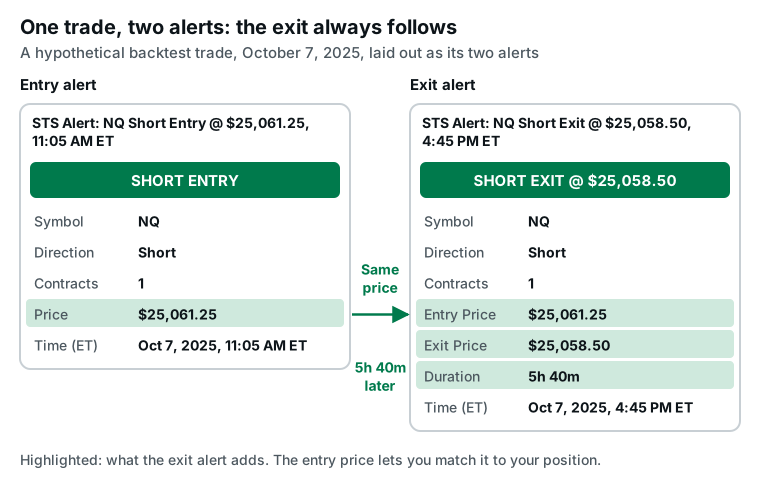
The book holds one position at a time, so an exit alert always closes the one trade that is open. Both alerts come by email from alerts@stsfutures.com and appear on the web dashboard's live feed, tagged with which of the four strategies fired. Browser push is optional.
Why is a set exit worth having?
Because, in our view, the exit is the hardest call to make in the moment: a winner tempts you to wait for more, and a loser tempts you to wait for it to come back.
With STS that call is already made. The book decides every exit by its rules, and the alert tells you when. You take the profit or cut the loss when it arrives, without a chart open.
The exit price also gives you a reference. You can set your own fill beside it and see how closely you followed.
How long after the entry does the exit come?
Usually the same day. In our hypothetical backtest, 2,331 of the 3,139 trades (74.3%) opened and closed on the same day, and the median trade lasted 5 hours 40 minutes.
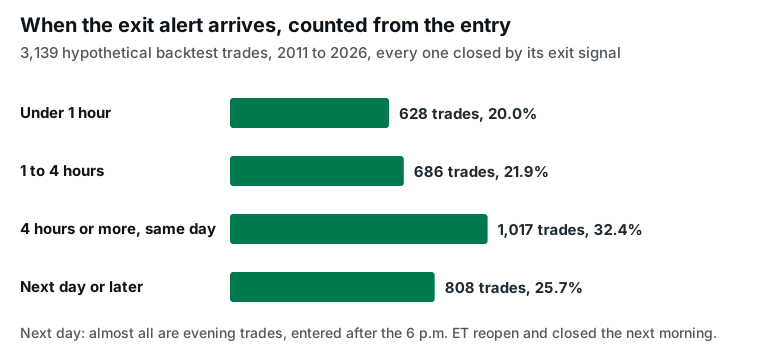
The 808 trades that closed the next day or later are almost all the book's evening trades: 795 entered after NQ reopens at 6 p.m. ET and closed the next day. Their exit alerts reach you the same way, so you need to see the alert, not watch the market: keep email or the dashboard where you will notice it during the hours you follow.
What this means for you
If knowing when to get out is the part of trading you find hardest, STS takes it off your hands: every trade you open from an entry alert ends with an exit alert. You place both orders yourself, on your own platform; nothing is placed for you.
STS costs $50 a month or $500 a year. Cancel anytime in Settings, and access runs to the end of the period you paid for. See the plans.
How we measured this
Every figure comes from our hypothetical backtest of the four-strategy NQ book: 3,139 trades from 2011 to 2026, data as of November 6, 2026, NQ mini, 1 or 2 contracts a trade (2 when daily ranges are small, 1 when they are large; every trade since July 2024 has been 1 contract). They are simulated trades, not results of live trading.
Trade length runs from the entry bar to the exit bar, in ET, and a same-day trade opened and closed on one calendar date. A trade without an exit would show as a position still open at the end of the record; there were none.
The example trade was chosen by rule: the most recent trade before July 6, 2026 that lasted exactly the median 5 hours 40 minutes. It is laid out in the current alert email format, with the backtest's prices and times. Every trade, with its entry and exit, is in the downloadable STS trade list.
We trade this book live and sell access to the signals, so judge the data accordingly. This article is educational and is not investment advice. Futures trading involves substantial risk of loss and is not suitable for every investor.
Hypothetical Performance Disclaimer (CFTC Rule 4.41): These results are based on simulated or hypothetical performance results that have certain inherent limitations. Unlike the results shown in an actual performance record, these results do not represent actual trading. Also, because these trades have not actually been executed, these results may have under- or over-compensated for the impact, if any, of certain market factors, such as lack of liquidity. Simulated or hypothetical trading programs in general are also subject to the fact that they are designed with the benefit of hindsight. No representation is being made that any account will or is likely to achieve profits or losses similar to these being shown.
Past performance is not necessarily indicative of future results. Futures trading involves substantial risk of loss and is not suitable for all investors.
See what STS NQ futures signals are and how they reach you and our forward record, every live signal we have sent, dated and public.