Late on an NQ Alert? A 30-Second Delay Kept 95.8% of Profit on 868 STS NQ Backtest Trades
Short answer. Acting 30 seconds late on both the entry and the exit kept 95.8% of the hypothetical profit across 868 STS backtest trades from June 2020 to May 2025. A full minute late kept 94.3% and two minutes late kept 94.7%, and the profit factor stayed between 1.62 and 1.64 against 1.67 on time. The deepest drawdown on these trades went from $18,789 on time to at most $22,757.
How much does a 30-second delay cost on an NQ alert?
An average of 1.09 NQ points per round trip, the entry and the exit together: $22 per NQ contract, or $2.18 per MNQ contract. That left 95.8% of the hypothetical profit.
We took every entry and every exit late, on all 868 trades. Each late fill is the market price at that moment, from 1-minute NQ prices, with no slippage added beyond the backtest's own.
| Delay on entry and exit | Average cost per round trip | Profit kept | Profit factor | Deepest closed-trade drawdown, these trades |
|---|---|---|---|---|
| On time | none | 100% | 1.67 | $18,789 |
| 30 seconds | 1.09 points ($22 per NQ, $2.18 per MNQ) | 95.8% | 1.64 | $19,704 |
| 1 minute | 1.50 points ($30 per NQ, $2.99 per MNQ) | 94.3% | 1.62 | $21,937 |
| 2 minutes | 1.49 points ($30 per NQ, $2.99 per MNQ) | 94.7% | 1.62 | $22,757 |
Profit factor is gross wins divided by gross losses. A drawdown is a fall from a previous high; these are for the book's own size of 1 or 2 NQ contracts a trade, over these 868 trades only.
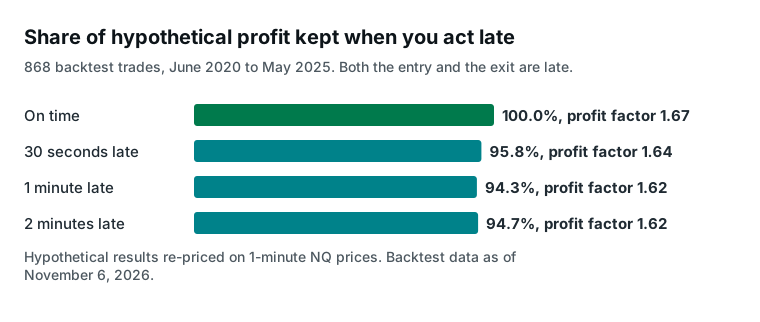
In the backtest, each calendar year in the window, including the partial years 2020 and 2025, stayed profitable at every delay.
Why doesn't a short delay cost more?
Because the average backtest trade earned far more than a minute of price drift took away, and the drift cut both ways. At one minute, the delay gave a better price on 45.3% of trades.
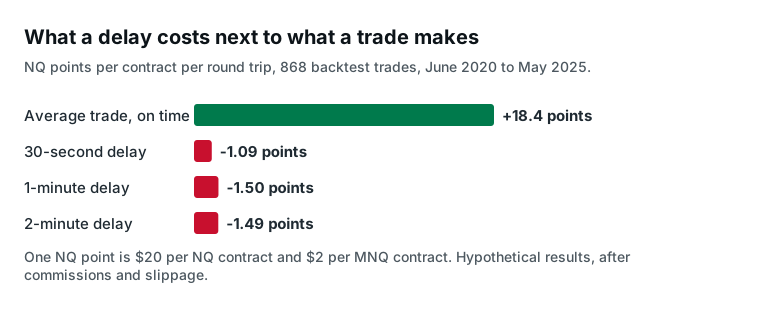
The average trade in this window made 18.4 points per contract after commissions and slippage. A one-minute delay took 1.50 of them.
Most of that cost sits on the entry, 0.91 points at one minute against 0.58 on the exit, which fits entries that follow momentum. Two minutes late cost no more than one minute, 1.49 points, a sign that over a minute or two the drift is mostly noise rather than a steady charge for waiting.
One NQ point is worth $20 per NQ contract and $2 per MNQ contract; NQ futures contract specs has the details.
How we measured this
Whose trades. Our four-strategy NQ book holds one position at a time and trades the NQ mini, 1 or 2 contracts a trade (2 when daily ranges are small, 1 when they are large; every trade since July 2024 has been 1 contract), with commissions and slippage included. Its TradingView backtest covers 2011 to 2026 (data as of November 6, 2026). The strategies follow momentum and trend, so these results describe our trades, not every NQ trade. All results are hypothetical.
Which trades. Our 1-minute CME NQ prices run from June 2020 to May 2025. That window holds 874 of the 3,139 backtest trades, and 868 of them, 27.7% of the book, had every bar the test needs.
How we re-priced fills. Each alert fires at the close of a five-minute bar, and 96.6% of entry prices matched the 1-minute price at that moment within half a point. For the 154 exits at a stop or target level, the alert time is the minute the level was touched. A late fill takes the 1-minute closing price one or two minutes after the alert. One-minute bars cannot show the price at exactly 30 seconds, so for that delay we used the average of the open, high, low and close of the minute after the alert; a straight-line midpoint instead keeps 97.1%.
The cost of each delay is the move against the trade on the entry plus the move against it on the exit, at $20 per point per NQ contract, with commissions and slippage as in the backtest. A result where late fills made the window unprofitable, or pushed profit factor below 1, would have contradicted the finding.
What this means for you
You do not need split-second reflexes to follow STS. In our test, taking every alert up to two minutes late still kept at least 94.3% of the hypothetical profit, with the deepest drawdown on these trades at most $22,757 against $18,789 on time. Half of a typical alert's emails have been confirmed delivered within 12 seconds of the signal, inside the shortest delay we tested, and you place each order yourself. A late fill is a small cost next to a skipped trade; the cost of skipping trades puts a number on skipping. Membership is $50 a month or $500 a year, and you can cancel anytime; see pricing.
We trade this book live and sell access to the signals, so judge the data accordingly. This article is educational and is not investment advice. Futures trading involves substantial risk of loss and is not suitable for every investor.
Hypothetical Performance Disclaimer (CFTC Rule 4.41): These results are based on simulated or hypothetical performance results that have certain inherent limitations. Unlike the results shown in an actual performance record, these results do not represent actual trading. Also, because these trades have not actually been executed, these results may have under- or over-compensated for the impact, if any, of certain market factors, such as lack of liquidity. Simulated or hypothetical trading programs in general are also subject to the fact that they are designed with the benefit of hindsight. No representation is being made that any account will or is likely to achieve profits or losses similar to these being shown.
Past performance is not necessarily indicative of future results. Futures trading involves substantial risk of loss and is not suitable for all investors.
See what STS NQ futures signals are and how they reach you and our forward record, every live signal we have sent, dated and public.